Best German Shepherd Food: Compared by Label
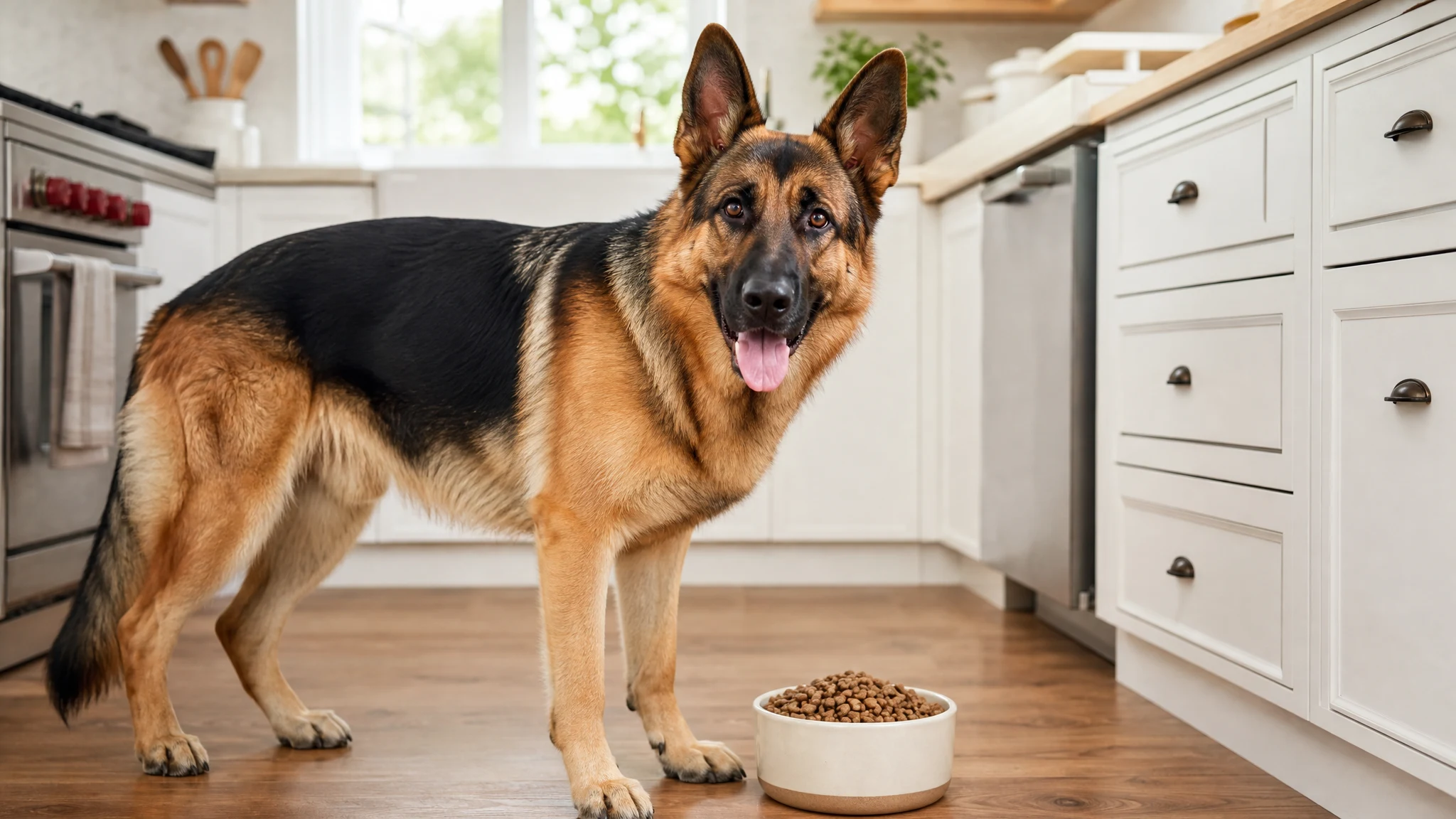
General nutrition information compiled from product labels and published sources, not veterinary advice. Your veterinarian is the right person to choose a diet for your dog, especially one with a health condition.
Picking the best German Shepherd food is mostly a reading exercise. Bags make big promises on the front. The facts sit on the back, in the adequacy statement, the ingredient list and the analysis panel.
This guide shows you how to read those parts and line up foods fairly. We compared label data only. We did not run feeding trials or taste tests, and nothing here says a food will prevent or treat any condition.
What you need before you start
- Your dog's age and a recent weight from your veterinarian.
- The bag or the brand's product page for each food you are considering.
- A notepad or spreadsheet with columns for life stage, AAFCO statement, protein, fat, calories per cup and first five ingredients.
- A kitchen scale or measuring cup, so you can follow a feeding guide accurately.
- Your veterinarian's phone number, because they make the final call for an individual dog.
Know the breed first
The American Kennel Club lists adult German Shepherd Dogs at 65 to 90 pounds for males and 50 to 70 pounds for females. Life expectancy is given as 12 to 14 years. That puts many dogs at or near the 70 pound line that pet food rules use for "large size" dogs.
The AKC also names bloat (gastric dilatation-volvulus), hip and elbow dysplasia and degenerative myelopathy as health topics for the breed. Those are reasons to read labels with care. They are not reasons to expect any bag to solve them.
Step 1: Match the life stage
Start by sorting foods by your dog's stage. A puppy, an adult and a senior need different formulas.
Royal Canin, for example, sells a German Shepherd puppy formula for 8 weeks to 15 months, an adult formula from 15 months and a 5+ formula from 5 years. Those ages are the manufacturer's own guidance. Hill's Science Diet lists a large breed adult food for dogs 1 to 5 years old and a 6+ large breed food. Brands draw the lines in different places, so check the stage on each product page.
Step 2: Read the AAFCO statement
The adequacy statement tells you whether a food is complete and balanced and for which life stage. For puppies it matters more than anything else on the bag.
The Kentucky Agricultural Experiment Station's rule 12 KAR 3:039 uses the AAFCO model wording. If a food's claim names "growth" or "All Life Stages," the label must add one of two phrases. One is "including growth of large size dogs (70 lb. or more as an adult)." The other is "except for growth of large size dogs (70 lb. or more as an adult)."
Because many German Shepherds finish near or above 70 pounds, a puppy food with the "including" phrase is the one to look for. Royal Canin's German Shepherd Puppy statement carries it. So does JustFoodForDogs' Chicken & Rice recipe, which is labeled for all life stages including large-size growth.
Hill's Science Diet Puppy Large Breed uses a feeding-test statement for "growing puppies" without the large-size phrase. Hill's labels that food for puppies over 55 pounds as adults. Ask your veterinarian whether that fits a dog likely to reach 70 pounds or more.
One caution. Royal Canin's German Shepherd Adult page prints an adequacy statement that names a different breed's formula. Treat that as something to verify against the actual bag, and ask the brand if it still reads that way.
Step 3: Compare protein, fat and calories fairly
Here is where people trip. Some brands print guaranteed minimums as fed. Hill's publishes average dry-matter values instead. Those numbers are not interchangeable, so do not rank a food on them across the two styles.
| Food (brand label data) | Stage | Protein | Fat | Calories | First ingredients |
|---|---|---|---|---|---|
| Royal Canin German Shepherd Adult, dry | Adult | 22% min | 17% min | 338 kcal ME per cup | Chicken by-product meal, brown rice, oat groats, chicken fat, corn |
| Royal Canin German Shepherd Puppy, dry | Puppy, large breed growth | 28% min | 14% min | 331 kcal ME per cup | Chicken by-product meal, corn, wheat gluten, oat groats, brewers rice |
| Royal Canin German Shepherd Adult 5+, dry | Senior | 23% min | 17% min | 321 kcal ME per cup | Brewers rice, corn, wheat gluten, chicken by-product meal, chicken fat |
| Hill's Science Diet Adult Large Breed Chicken & Barley, dry | Adult 1 to 5 years | 23.8% (dry matter average) | 15% (dry matter average) | 365 kcal per cup | Chicken, cracked pearled barley, brown rice, brewers rice, whole grain wheat |
| Hill's Science Diet Puppy Large Breed Chicken & Brown Rice, dry | Large breed puppy | 26.3% (dry matter average) | 15.4% (dry matter average) | 391 kcal per cup | Chicken, brown rice, whole grain oats, chicken meal, cracked pearled barley |
| Hill's Science Diet Adult 6+ Large Breed, dry | Senior 6+ | 18.7% (dry matter average) | 13.5% (dry matter average) | 352 kcal per cup | Chicken meal, cracked pearled barley, brewers rice, whole grain wheat, whole grain corn |
| JustFoodForDogs Chicken & Rice, fresh frozen | All life stages incl. large-size growth | 8% min (as fed) | 3% min (as fed) | 43 kcal ME per oz | Chicken, long-grain white rice, long-grain brown rice, carrots, kale |
Fresh and canned foods hold a lot of water, so their as-fed percentages look low next to kibble. That does not make them weaker or stronger. It only means you need calories, not percentages, to compare portions.
You can see more foods compared side by side by label on our full comparison page.
Step 4: Read the first five ingredients with a skeptical eye
Ingredients are listed by weight before cooking. Several foods above lead with a "by-product meal" or a "meal." A meal is a concentrated ingredient with water removed, so it can outweigh fresh chicken once the water is counted. Neither word is good or bad on its own.
Look at the whole list instead of one item. Note whether grains appear and whether peas, lentils or other legumes sit high on the list.
The U.S. FDA has investigated reports of non-hereditary dilated cardiomyopathy (DCM) in dogs. It received 1,382 reports from January 1, 2014 to November 1, 2022. The reports involve both grain-free and grain-containing diets. Most implicated diets list peas, lentils or similar pulses high in the ingredients. The FDA also says report counts alone do not establish cause, and it has not requested recalls. Every food in the table above is listed as not grain-free. If you are weighing a grain-free diet, talk to your veterinarian first.
Step 5: Turn the label into a feeding plan
Feeding guides are starting points, not rules. Use them to set a first amount, then adjust with your veterinarian based on your dog's body condition.
- Royal Canin's puppy table lists 2 7/8 cups a day for a 2-month-old puppy with a target adult weight of 57 pounds. Your puppy's own target weight changes that number.
- Hill's adult large breed guide lists 3 2/3 cups a day for a 60 pound dog.
- Royal Canin's adult page recommends 2 to 4 equal portions per day.
Cornell University's Riney Canine Health Center lists feeding-related bloat risk factors. These include eating too quickly, one large meal a day, raised bowls and exercise soon after eating. Cornell suggests two or more meals a day with smaller kibble. Splitting the daily amount is a reasonable habit to ask your veterinarian about.
Step 6: Be careful with puppy growth
Cornell says hip dysplasia is genetic but modified by nutrition and growth rate. It advises avoiding overfeeding fast-growing large-breed puppies and feeding diets formulated for large breeds while they grow. It also advises against adding calcium or vitamin D to a growing puppy's diet.
In practice, that means measuring portions, not free-feeding, and skipping supplements unless your veterinarian recommends them. A trim puppy is the goal, as long as essential nutrients are not cut.
Step 7: Check with your veterinarian and transition slowly
Share your shortlist with your veterinarian. This matters most if your dog has digestive trouble. German Shepherds are described as predisposed to exocrine pancreatic insufficiency in a Mississippi State University College of Veterinary Medicine conference paper. Weight loss with poor digestion deserves a vet visit, not a food swap. Prescription diets are something only a veterinarian prescribes.
When you do change foods, mix the new food into the old over several days. Ask your veterinarian how long to take.
Common mistakes to avoid
- Ranking on front-of-bag claims. Words like "premium" or "natural" are not nutrient data.
- Comparing as-fed and dry-matter numbers directly. They are measured differently.
- Ignoring calories. Cups differ in calories from food to food, so the same scoop can be a very different meal.
- Feeding an adult food to a growing puppy. Check for the large-size growth phrase.
- Trusting a page over the bag. If a statement looks wrong, confirm it with the brand.
- Adding calcium or other supplements to a puppy's meals. Cornell advises against it.
What to expect
If you follow these steps, you will likely end up with a short list of foods that suit your dog's age and size. You should also be able to explain why each one made the list.
Over the following weeks, many owners find steady energy, a healthy body condition and normal stools are signs a food suits their dog. Results vary by dog. A label comparison cannot promise a particular outcome or protect against any disease. Your veterinarian's checks of weight and condition are the real test.
Sources
- American Kennel Club, German Shepherd Dog breed page
- Cornell University College of Veterinary Medicine, Gastric dilatation volvulus (GDV) or bloat
- Cornell University College of Veterinary Medicine, Canine hip dysplasia
- U.S. FDA, Questions & Answers on non-hereditary DCM in dogs
- Kentucky Agricultural Experiment Station, 12 KAR 3:039 Nutritional adequacy
- Mississippi State University College of Veterinary Medicine, Canine Exocrine Pancreatic Insufficiency paper
- Royal Canin, German Shepherd Adult
- Royal Canin, German Shepherd Puppy
- Royal Canin, German Shepherd Adult 5+
- Hill's Science Diet, Adult Large Breed
- Hill's Science Diet, Puppy Large Breed
- Hill's Science Diet, Adult 6+ Large Breed
- JustFoodForDogs, Chicken & Rice Recipe