Good Dog Food for German Shepherd: What Makes a Food Good for This Breed
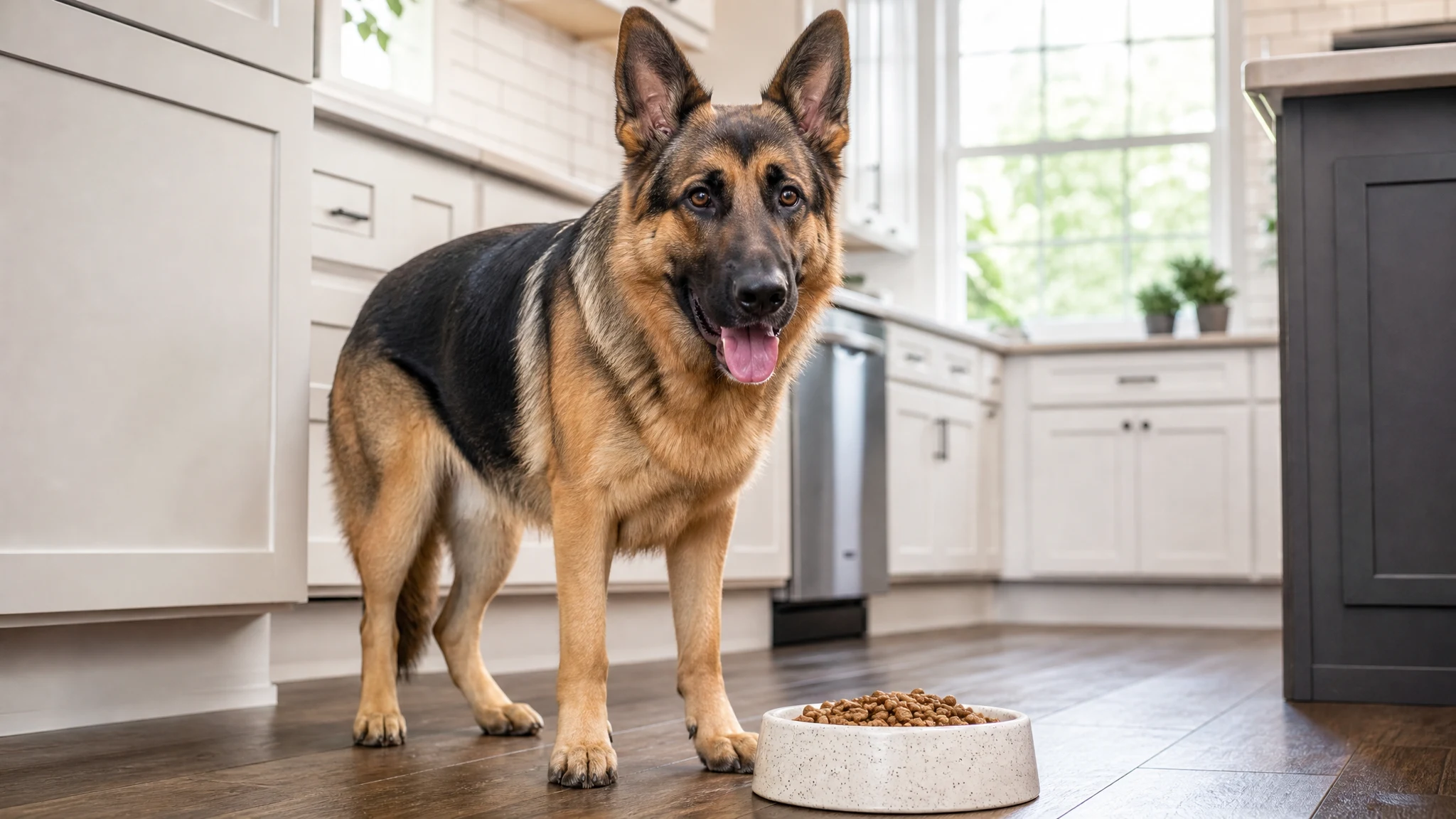
General nutrition information compiled from product labels and published sources, not veterinary advice. Your veterinarian is the right person to choose a diet for your dog, especially one with a health condition.
Bags promise a lot. Most of the promises are marketing. What you can actually check is the label: the adequacy statement, the life stage, the numbers, and the first ingredients.
This guide walks through that check in order. It is a method for reading labels, not a verdict on one bag. A veterinarian decides what suits an individual dog.
What you need before you start
- Your dog's age and current weight.
- The bag or the brand's product page for each food you are weighing.
- A notepad or spreadsheet for notes.
- Your veterinarian's notes on any health concerns your dog has.
Step 1: Know the size and growth pattern of the breed
The AKC lists adult German Shepherd Dogs at 65 to 90 pounds for males and 50 to 70 pounds for females. The AKC gives a life expectancy of 12 to 14 years.
That puts many dogs at or near 70 pounds, which matters in Step 3. It also means a puppy is growing a large frame, and growth is where food choices count most.
Step 2: Match the food to the life stage
A good dog food for German Shepherd households starts with the right stage. Puppy, adult and senior foods are built differently.
As one example of manufacturer guidance, Royal Canin feeds its German Shepherd puppy formula from 8 weeks to 15 months, its adult formula from 15 months, and its 5+ formula from 5 years. I found no parent club or veterinary school age cutoff, so treat those ages as one brand's schedule. Ask your veterinarian when to switch your dog.
Step 3: Read the adequacy statement
Find the sentence that starts with something like "formulated to meet" or "animal feeding tests substantiate." It tells you the life stage the food is designed for.
For puppies, look for one more phrase. The Kentucky Agricultural Experiment Station rule 12 KAR 3:039, which uses the AAFCO model wording, says a food that claims growth or all life stages must add one of two phrases. One is "including growth of large size dogs (70 lb. or more as an adult)." The other is "except for growth of large size dogs (70 lb. or more as an adult)."
Since many German Shepherds reach that 70 pound line, a puppy food with the "including" phrase is the safer match. Cornell's Riney Canine Health Center also advises feeding diets formulated for large breeds while puppies grow.
Step 4: Check the numbers and the calories
Look at protein, fat and fiber, then calories per cup. Calories matter because Cornell says overfeeding and rapid growth can worsen hip dysplasia in predisposed puppies. It also says nutrition and growth rate modify that risk. No food prevents or treats the condition.
Cornell also advises against adding calcium or vitamin D to a growing puppy's diet. Do not add supplements unless your veterinarian says so.
One catch: Hill's Science Diet publishes average dry-matter values, not guaranteed minimums and maximums. The two sets of numbers cannot be compared line for line. Royal Canin and JustFoodForDogs publish guaranteed analysis, and JustFoodForDogs' figures are as fed, so moisture changes the picture.
Step 5: Look at the first ingredients
Ingredients are listed by weight, so the first five show the base of the recipe. Note what the main protein is and which grains are used. Judge ingredient claims by what the list says, not by what the front of the bag implies.
The FDA's work on dilated cardiomyopathy (DCM) is worth knowing about. The FDA says its reports involve both grain-free and grain-containing diets. Most of the diets named list peas, lentils or other non-soy legumes high in the ingredients. The FDA also says report counts alone do not establish a causal relationship, and it has not requested recalls. It says it has no definitive information that these diets are inherently unsafe.
The practical takeaway is to read the list and ask your veterinarian about any diet question, including grain-free.
Step 6: Compare on label data only
The table below compares label data from the brands' own pages. I did not run feeding trials or taste tests, so it says nothing about how a dog does on a food. Hill's protein and fat are dry-matter averages. Royal Canin and JustFoodForDogs are guaranteed minimums as fed.
| Food | Life stage | Protein / fat | Calories | First ingredients |
|---|---|---|---|---|
| Royal Canin German Shepherd Puppy (dry) | Growth, including large size dogs | 28% / 14% min | 331 kcal ME per cup | Chicken by-product meal, corn, wheat gluten, oat groats, brewers rice |
| Royal Canin German Shepherd Adult (dry) | Adult maintenance | 22% / 17% min | 338 kcal ME per cup | Chicken by-product meal, brown rice, oat groats, chicken fat, corn |
| Royal Canin German Shepherd Adult 5+ (dry) | Maintenance, 5 years and older | 23% / 17% min | 321 kcal ME per cup | Brewers rice, corn, wheat gluten, chicken by-product meal, chicken fat |
| Hill's Science Diet Puppy Large Breed Chicken & Brown Rice (dry) | Growing puppies (feeding tests) | 26.3% / 15.4% dry matter | 391 kcal per cup | Chicken, brown rice, whole grain oats, chicken meal, cracked pearled barley |
| Hill's Science Diet Adult Large Breed Chicken & Barley (dry) | Adult maintenance (feeding tests) | 23.8% / 15% dry matter | 365 kcal per cup | Chicken, cracked pearled barley, brown rice, brewers rice, whole grain wheat |
| JustFoodForDogs Chicken & Rice (fresh frozen) | All life stages, including large size growth | 8% / 3% min, as fed | 43 kcal ME per oz | Chicken, long-grain white rice, long-grain brown rice, carrots, kale |
Three things stand out from the labels. The Royal Canin puppy food and the JustFoodForDogs recipe carry the "including" large-size wording. Hill's lists its large breed puppy food for dogs over 55 pounds as adults and uses a feeding-test statement for "growing puppies" without the large-size phrase. Check the bag if your puppy may reach 70 pounds or more.
Calories per cup also vary between foods, so a cup of one is not a cup of another. The Royal Canin adult formula's online page prints an adequacy statement that names a different breed's formula. Check the statement on the bag you buy.
For a wider look at options, see our label comparison of foods for German Shepherds.
Step 7: Plan how you feed, not only what you feed
Cornell lists feeding habits among the risk factors for bloat (gastric dilatation-volvulus): eating too quickly, one large meal a day, raised food bowls, and exercise soon after eating. It suggests two or more meals a day and smaller kibble. The AKC also lists bloat among the health concerns for the breed.
Brand guides are only starting points. Royal Canin's adult page suggests 2 to 4 equal portions a day. Its puppy table lists 2 7/8 cups per day at 2 months for a puppy with a target adult weight of 57 pounds. Hill's lists 3 2/3 cups a day of its adult large breed food for a 60 pound dog. Your dog's body condition and your veterinarian's advice set the real amount.
Step 8: Switch foods slowly and watch
Do not change foods overnight. Mix the new food in gradually. Track stool, energy and body shape in your notes. Weigh the dog regularly.
Some German Shepherds have a digestive condition called exocrine pancreatic insufficiency (EPI). The Mississippi State University College of Veterinary Medicine describes the breed as predisposed, with maldigestion and weight loss as signs. No food treats it. Ongoing weight loss or poor digestion is a reason to call your veterinarian, not to hunt for a new bag.
Tips and common mistakes
- Judging by the front of the bag. Breed names and pictures are marketing. The adequacy statement is the part with meaning.
- Using an adult food for a growing puppy. Check that the statement covers growth.
- Feeding a puppy to look big. Cornell advises against overfeeding fast-growing large-breed puppies. Keep them lean without cutting essential nutrients.
- Adding calcium or vitamin D. Cornell advises against it for growing puppies.
- Treating a food as medicine. Only a veterinarian prescribes a therapeutic diet.
- Trusting one number. Protein alone says little. Look at calories, life stage and the whole label.
What results to expect
A food that fits your dog's life stage, with sensible portions, may support steady growth in puppies and a healthy weight in adults. Results vary by dog. Coat, stool and energy can change for many reasons, so a new food may or may not make a visible difference.
Parents and breeders handle joint health differently. The German Shepherd Dog Club of America health statement, hosted by the AKC, calls for OFA hip and elbow results for health certification. Food does not replace that screening. Cornell notes that elbow dysplasia is highly prevalent in the breed and that hip dysplasia is common.
Sources
- AKC, German Shepherd Dog breed page
- Cornell Riney Canine Health Center, Canine hip dysplasia
- Cornell Riney Canine Health Center, Gastric dilatation volvulus (GDV) or bloat
- Cornell Riney Canine Health Center, Elbow dysplasia
- Kentucky 12 KAR 3:039, Nutritional adequacy
- U.S. FDA, Questions and Answers on non-hereditary DCM in dogs
- Royal Canin, German Shepherd Puppy
- Royal Canin, German Shepherd Adult
- Royal Canin, German Shepherd Adult 5+
- Hill's Science Diet, Puppy Large Breed
- Hill's Science Diet, Adult Large Breed
- JustFoodForDogs, Chicken & Rice Recipe
- German Shepherd Dog Club of America Health Statement, December 2015
- Mississippi State University College of Veterinary Medicine, Canine Exocrine Pancreatic Insufficiency