Royal Canin Adult German Shepherd Dry Dog Food: Reading the Label
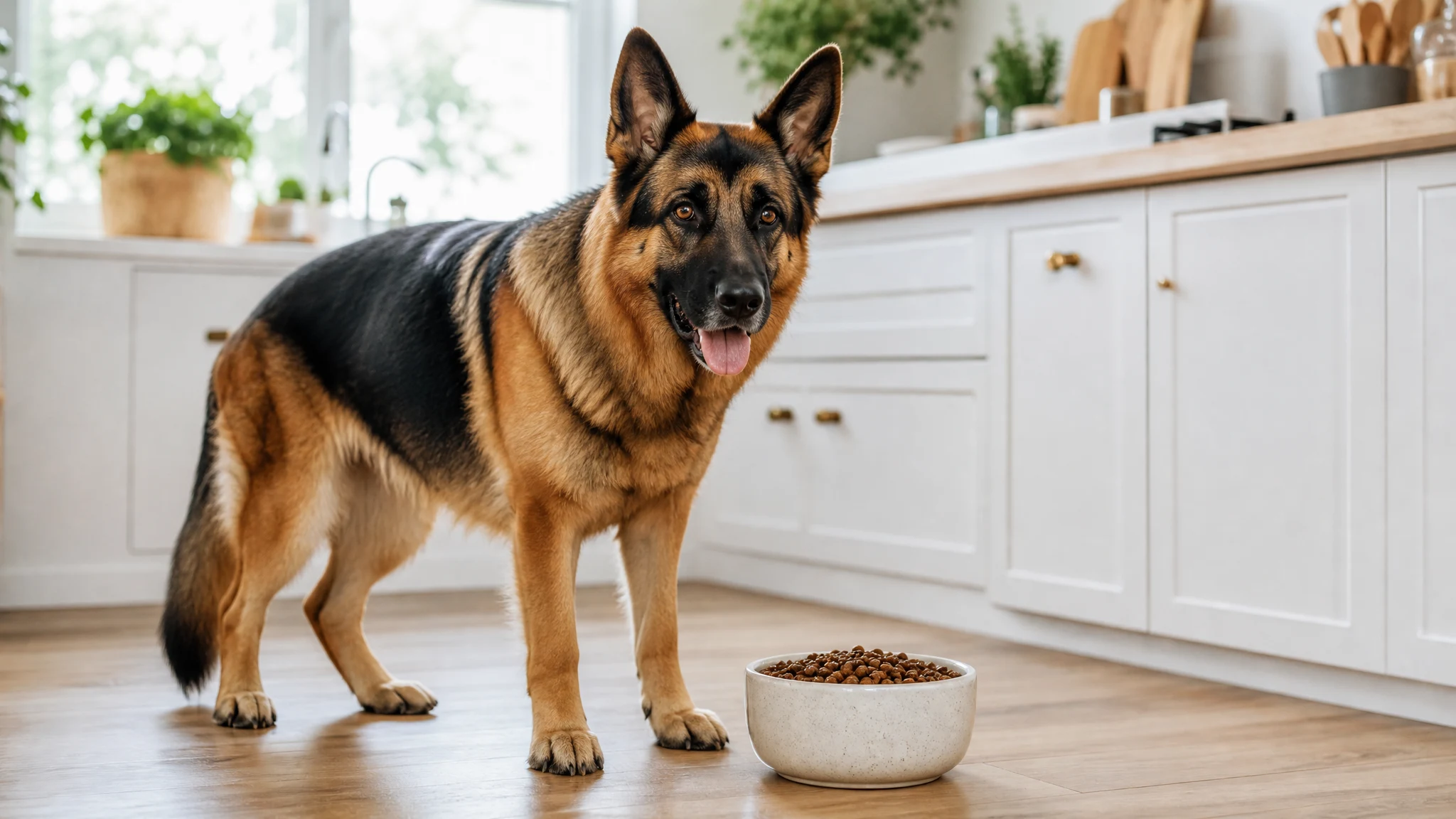
General nutrition information compiled from product labels and published sources, not veterinary advice. Your veterinarian is the right person to choose a diet for your dog, especially one with a health condition.
A bag of dog food makes a lot of claims on the front. The facts that matter are on the back. This guide walks through the label on Royal Canin Adult German Shepherd Dry Dog Food, one step at a time, so you can see what it says and what it leaves out.
We compared label data only. We did not run feeding trials or taste tests, and nothing here says a food will prevent or treat any condition. Your veterinarian decides what is right for your individual dog.
What you need
- The bag of food, or the product page from Royal Canin's German Shepherd Adult page.
- Your dog's age and current weight.
- A measuring cup and a kitchen scale, if you have one.
- A notepad or phone to write down the numbers.
- A second food label for comparison, if you want one.
Step 1: Check that your dog is the right age
Royal Canin describes this formula for purebred German Shepherds over 15 months old. It uses its puppy formula from 8 weeks to 15 months, and a separate 5+ formula from 5 years. That is the manufacturer's own guidance, not a universal rule. Your veterinarian can tell you when your dog should switch.
For size, the AKC lists adult male German Shepherd Dogs at 65 to 90 pounds and females at 50 to 70 pounds. Write down where your dog falls.
Step 2: Find the adequacy statement
Look for a sentence that starts with something like "formulated to meet the nutritional levels established by the AAFCO Dog Food Nutrient Profiles." It should name a life stage. For this adult food, the life stage is maintenance.
Maintenance is the right match for a fully grown dog. It is not the right match for a growing puppy.
There is one thing to check carefully. The adequacy statement printed on Royal Canin's own German Shepherd Adult product page names a different breed's adult formula. That looks like a page error. Do not rely on the web page for this step. Read the statement on the bag in your hands. If the bag and the page disagree, contact Royal Canin and ask which is correct.
Step 3: Read the guaranteed analysis
The guaranteed analysis lists minimums and maximums, measured as fed (including the moisture in the kibble). For this food, Royal Canin lists:
- Crude protein: 22.0% minimum
- Crude fat: 17.0% minimum
- Crude fiber: 4.8% maximum
A minimum means the food contains at least that much. It could contain more. The numbers tell you the rough balance of the food. They do not tell you the quality of the protein or how well your dog digests it.
Step 4: Read the first five ingredients
Ingredients are listed by weight before cooking. The first five on this food are:
- Chicken by-product meal
- Brown rice
- Oat groats
- Chicken fat
- Corn
Two things stand out. The food is not grain-free. And the protein source is a by-product meal, which is a rendered ingredient. The word "by-product" sounds alarming, but a label alone does not make it good or bad. It is simply what the label says, and it is worth knowing before you buy.
The U.S. FDA has looked at reports of diet-associated dilated cardiomyopathy (DCM) in dogs. It received 1,382 reports between January 1, 2014 and November 1, 2022. The reports involve both grain-free and grain-containing diets. The FDA says report counts alone do not establish a causal relationship, and it has not requested recalls. If you have concerns about heart health and diet, raise them with your veterinarian.
Step 5: Work out the calories
Royal Canin lists 338 kcal ME per cup, which is 3,803 kcal ME per kilogram. Calories per cup matter because two foods with the same cup size can deliver very different energy.
When you switch foods, do not assume the same cup measure applies. Compare calories per cup between the old and new food. Then adjust the amount with your veterinarian's input.
Step 6: Look at the feeding guide and kibble
Royal Canin recommends feeding this food in 2 to 4 equal portions per day. Treat the chart on the bag as a starting point. Watch your dog's body condition over several weeks and adjust with your veterinarian.
Splitting the day's food into more than one meal also lines up with advice from Cornell University's Riney Canine Health Center on bloat (gastric dilatation-volvulus, or GDV). Cornell lists feeding once daily or in large meals, eating too quickly, and exercise soon after eating as risk factors. It suggests two or more meals a day. The AKC lists bloat among the health concerns for the breed.
The brand says the kibble has a shape and texture designed for a German Shepherd's long, strong muzzle and teeth. We have no size measurement to report, so check the bag or ask Royal Canin if kibble size matters to you.
Step 7: Compare with another food, label to label
Comparison only works when you line up the same facts. Here is how this food looks beside one large-breed adult option from Hill's Science Diet, based on each brand's published label data.
| Item | Royal Canin German Shepherd Adult (dry) | Hill's Science Diet Adult Large Breed Chicken & Barley (dry) |
|---|---|---|
| Life stage | Adult, over 15 months | Adult, 1 to 5 years, ideal weight 55 to 110 lb |
| First ingredients | Chicken by-product meal, brown rice, oat groats, chicken fat, corn | Chicken, cracked pearled barley, brown rice, brewers rice, whole grain wheat |
| Protein | 22.0% minimum, as fed | 23.8% average, dry matter |
| Fat | 17.0% minimum, as fed | 15% average, dry matter |
| Calories | 338 kcal ME per cup | 365 kcal per cup |
Do not read the protein and fat rows straight across. Royal Canin prints as-fed minimums. Hill's publishes dry-matter averages, which are calculated differently and usually look higher. For a fair comparison, ask each brand for the same type of number. Our broader label comparison of dog foods for German Shepherds shows how we handle this across products.
Tips and common mistakes
- Trusting the breed name alone. A breed name on the bag is a marketing choice. The adequacy statement and analysis are what tell you the nutrition basis.
- Using an adult food for a puppy. Growing large-breed puppies need a formula that names growth, with the large-size wording "including growth of large size dogs (70 lb. or more as an adult)." Cornell advises feeding large-breed diets while growing, avoiding overfeeding, and not adding calcium or vitamin D. Royal Canin's German Shepherd Puppy carries that large-size wording.
- Comparing mismatched numbers. As-fed and dry-matter values are not interchangeable.
- Ignoring calories. Cups mean little without kcal per cup.
- Switching all at once. Ask your veterinarian how to transition, and watch your dog's stool and appetite.
- Expecting a food to fix a health problem. Hip and elbow dysplasia, degenerative myelopathy and exocrine pancreatic insufficiency are medical conditions. Any diet change for them belongs in your veterinarian's hands.
What to expect
Once you have worked through the steps, you should have a short page of notes. It should cover the life stage, the adequacy statement as printed on your bag, the analysis, the first ingredients and the calories per cup.
That may help you ask your veterinarian better questions and compare foods more fairly. It will not tell you how your dog will do on a food. Weight, energy, coat and stool over several weeks are better guides, and your veterinarian can interpret them.
A label also cannot tell you everything. The AAFCO statement, ingredient order and analysis are a starting point, not a verdict.
Sources
- Royal Canin US, German Shepherd Adult Dry Dog Food
- Royal Canin US, German Shepherd Puppy Dry Dog Food
- Hill's Science Diet Adult Large Breed Chicken & Barley Recipe
- AKC, German Shepherd Dog breed page
- Cornell University College of Veterinary Medicine, Gastric dilatation volvulus (GDV) or bloat
- Cornell University College of Veterinary Medicine, Canine hip dysplasia (CHD)
- Kentucky Agricultural Experiment Station, 12 KAR 3:039 Nutritional adequacy
- U.S. FDA, Questions & Answers: FDA's Work on Potential Causes of Non-Hereditary DCM in Dogs