Batch-Prepping and Storing a German Shepherd's Food Safely
General nutrition information compiled from product labels and published sources, not veterinary advice. Your veterinarian is the right person to choose a diet for your dog, especially one with a health condition.
Weeknights get busy. Pre-portioning a German Shepherd's meals can save time and make it easier to feed the same amount at the same times. It also means food sits in containers, so storage matters.
This guide covers dog feeding preparation for the week ahead: measuring, splitting into meals, storing and serving. It covers dry, canned and fresh foods. The amounts come from the manufacturers' own feeding guides and are starting points only.
Why batch prep suits a German Shepherd
The AKC lists adult German Shepherd males at 65 to 90 pounds and females at 50 to 70 pounds. Dogs this size eat a lot, so measuring by eye drifts easily.
The AKC also lists bloat (gastric dilatation-volvulus) among the breed's health concerns. Cornell University's Riney Canine Health Center names feeding habits among the risk factors: eating too quickly, feeding once daily or in large meals, raised food bowls, and exercise soon after eating. Cornell suggests two or more meals a day with smaller kibble.
Pre-portioned meals make it simple to split the day's food into two or more servings. They do not prevent bloat, and a veterinarian is the right person to ask about your own dog's risk.
Materials you will need
- A kitchen scale or a standard dry measuring cup. A scale is more consistent than a scoop.
- Airtight food-safe containers for dry food, or small lidded containers for portions of wet or fresh food.
- Freezer-safe containers if you are using a frozen fresh food.
- Masking tape and a marker to label each container with the date and the meal.
- The food's own packaging or label, kept or photographed, so you can check the feeding guide and storage directions.
- A dedicated scoop, spoon and a clean work surface.
Step-by-step: batch-prepping the week's meals
1. Settle the daily amount first
Start with your dog's age, current weight and activity level, then read the feeding guide on your food's label. Treat the figure as a starting point and adjust with your veterinarian based on body condition.
Our German Shepherd feeding chart by age explains how to think about amounts across life stages.
A few examples show how much label guides vary by food:
- Royal Canin's German Shepherd Puppy page gives 2 7/8 cups (262 g) per day for a 2-month-old puppy with a target adult weight of 57 lb (26 kg).
- Hill's Science Diet Adult Large Breed Chicken & Barley lists 3 2/3 cups (365 g) per day for a 60 lb (27 kg) adult.
- Royal Canin's German Shepherd Adult 5+ table lists 3 1/4 cups (279 g) for low activity, 4 1/4 cups (367 g) for medium and 5 cups (426 g) for high activity, for a 57 lb (26 kg) dog.
Cups differ between foods because the calories per cup differ. Never carry a cup measure from one food over to another.
2. Decide how many meals per day
Royal Canin's adult German Shepherd page recommends 2 to 4 equal portions per day. Cornell suggests two or more meals daily. Pick a schedule you can keep, such as morning and evening, and divide the daily amount by the number of meals.
3. Wash up and set up a clean station
Wash your hands, the scoop and the containers. Dry everything before you add food, since moisture in a container is a poor match for stored kibble.
4. Weigh or measure each meal
Weigh each portion on the scale if the label gives grams. If you use cups, level them off rather than heaping. Put one meal in each container.
5. Label and date every container
Write the date and the meal (for example, "Tue PM") on the tape. Keep the food's brand and formula name nearby, either on the container or on a note on the fridge. If a food ever has a recall or a question, you will know what you fed.
6. Store each type of food the way its label says
Storage differs by food type, so follow the directions on your package:
- Dry kibble: Keep the main bag closed and stored as the package directs. Portioned containers should be sealed and kept away from moisture.
- Canned food: Unopened cans are not part of batch prep. Once opened, move the food to a covered container and check the label for refrigeration and how long it keeps.
- Refrigerated fresh roll: The Hill's Science Diet Adult Single Protein Chicken & Brown Rice roll says to keep it refrigerated at all times below 40°F (4°C) and not to freeze it.
- Fresh frozen food: JustFoodForDogs directs you to store its Chicken & Rice Recipe in the freezer and thaw it in the refrigerator.
These two fresh foods have opposite rules, one "do not freeze" and one "freeze". This is exactly why you should read each label rather than apply one habit to everything. For how long an opened or thawed product keeps, check the brand's own page or customer line. We do not give a number of days here because it depends on the food.
7. Thaw and serve with care
If a frozen food is thawed in the refrigerator, move the next day's portions over the night before. Serve at the temperature the brand suggests. Use a clean bowl at each meal.
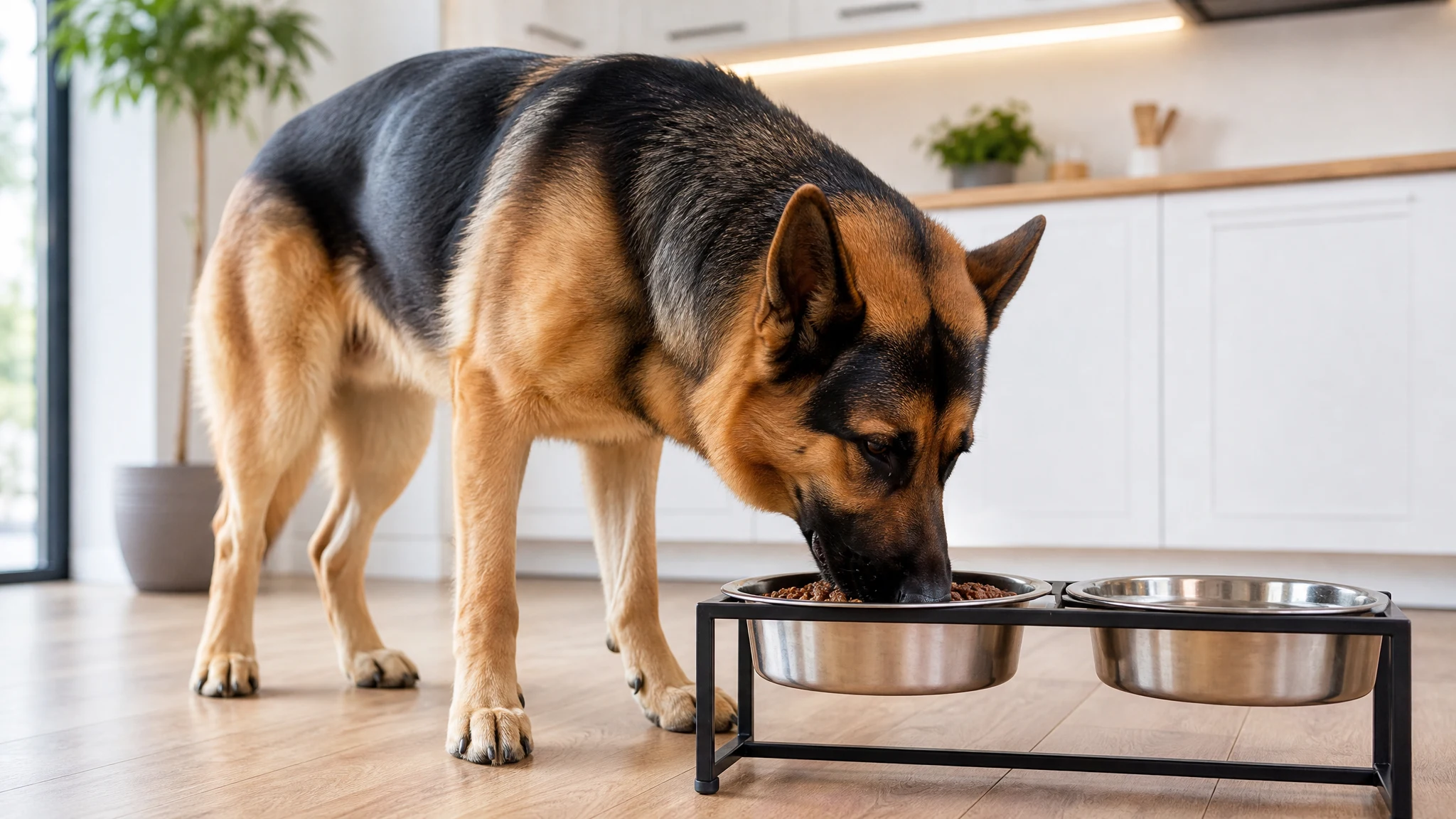
Do not feed from a raised bowl on the assumption that it helps. Cornell lists raised food bowls among the feeding-related risk factors for bloat.
Special notes by life stage
Puppies
Cornell advises feeding fast-growing large-breed puppies a diet formulated for large breeds, avoiding overfeeding, and not adding calcium or vitamin D supplements. Batch prep helps because exact portions make overfeeding harder.
On the label, look for the AAFCO adequacy statement. A food for large puppies should say it covers growth "including growth of large size dogs (70 lb. or more as an adult)." The Kentucky Agricultural Experiment Station's rule 12 KAR 3:039 explains that wording. Royal Canin's German Shepherd Puppy carries that phrase. Hill's Science Diet Puppy Large Breed uses a different statement, saying it provides complete and balanced nutrition for growing puppies, so read it and ask your veterinarian if you are unsure.
Adults and seniors
Royal Canin lists its German Shepherd adult formula from 15 months and its 5+ formula from 5 years. Hill's lists its large breed adult formula for ages 1 to 5 years and its 6+ formula after that. Check the exact stage on your bag.
One more label note: Royal Canin's German Shepherd Adult page prints an adequacy statement that names a different breed formula. Check the statement on the bag you actually buy.
Dogs with a health condition
If your dog has a health condition, a sensitive stomach or a diagnosis such as exocrine pancreatic insufficiency, confirm both the food and the amounts with your veterinarian before you batch prep. Only a veterinarian can prescribe a therapeutic diet, and no ordinary food on this page is a treatment for any condition.
Tips for smoother batch prep
- Prep on the same day each week so it becomes routine.
- Keep a small spare container for a dog who needs a slightly bigger or smaller meal. Adjust gradually.
- Weigh your dog regularly and note changes. Amounts that worked last month may need to shift.
- Switch foods slowly and ask your veterinarian how, rather than changing a whole week of containers at once.
- Wash reusable containers between batches and let them dry fully.
Common mistakes to avoid
- Using one measuring cup for every food. Calories per cup vary. Royal Canin lists 338 kcal per cup for its adult German Shepherd kibble and Hill's lists 365 kcal per cup for its adult large breed kibble.
- Mixing old and new food in the same container. Old crumbs can hold moisture and make it harder to track what was fed.
- Skipping the date. Unlabeled containers lead to guesswork about how long food has sat.
- Treating a label guide as a fixed prescription. It is a starting point. Hill's own puppy page says to adjust amounts to maintain optimal weight and to ask your veterinarian if unsure.
- Letting the dog gulp the meal and run. Cornell lists eating too quickly and exercise soon after eating as risk factors for bloat.
- Adding supplements to a growing puppy's batch. Cornell advises against calcium or vitamin D supplements for growing puppies. Ask your veterinarian before adding anything.
What to expect
Batch prep may make mealtimes calmer, since the food is ready and the portions are consistent. Measured, regular meals can also make it easier to spot changes in appetite or body condition early, which you can then raise with your veterinarian.
It will not make a food better or worse for your dog. The food itself still needs to be complete and balanced for your dog's life stage, and results vary between dogs. A prep routine is only as good as the food and amounts you put in it.
If your dog refuses meals, loses weight, vomits or has a swollen, tight belly, contact a veterinarian promptly.
A note on the foods named here
The products above are mentioned only for their label data: the adequacy statement, feeding guide and storage directions. We compared label information. We did not run feeding trials or taste tests, and we are not recommending one brand over another. Current formulas, ingredients and storage directions are on each brand's own page.
Sources
- AKC, German Shepherd Dog breed page
- Cornell University College of Veterinary Medicine, Gastric dilatation volvulus (GDV) or bloat
- Cornell University College of Veterinary Medicine, Canine hip dysplasia (CHD)
- Kentucky Agricultural Experiment Station, 12 KAR 3:039 Nutritional adequacy
- Royal Canin, German Shepherd Puppy
- Royal Canin, German Shepherd Adult
- Royal Canin, German Shepherd Adult 5+
- Hill's Science Diet, Adult Large Breed Chicken & Barley
- Hill's Science Diet, Adult Single Protein Chicken & Brown Rice Fresh Roll
- Hill's Science Diet, Puppy Large Breed Chicken & Brown Rice
- JustFoodForDogs, Chicken & Rice Recipe