Best Food for German Shepherd: Adjusting Portions as They Grow
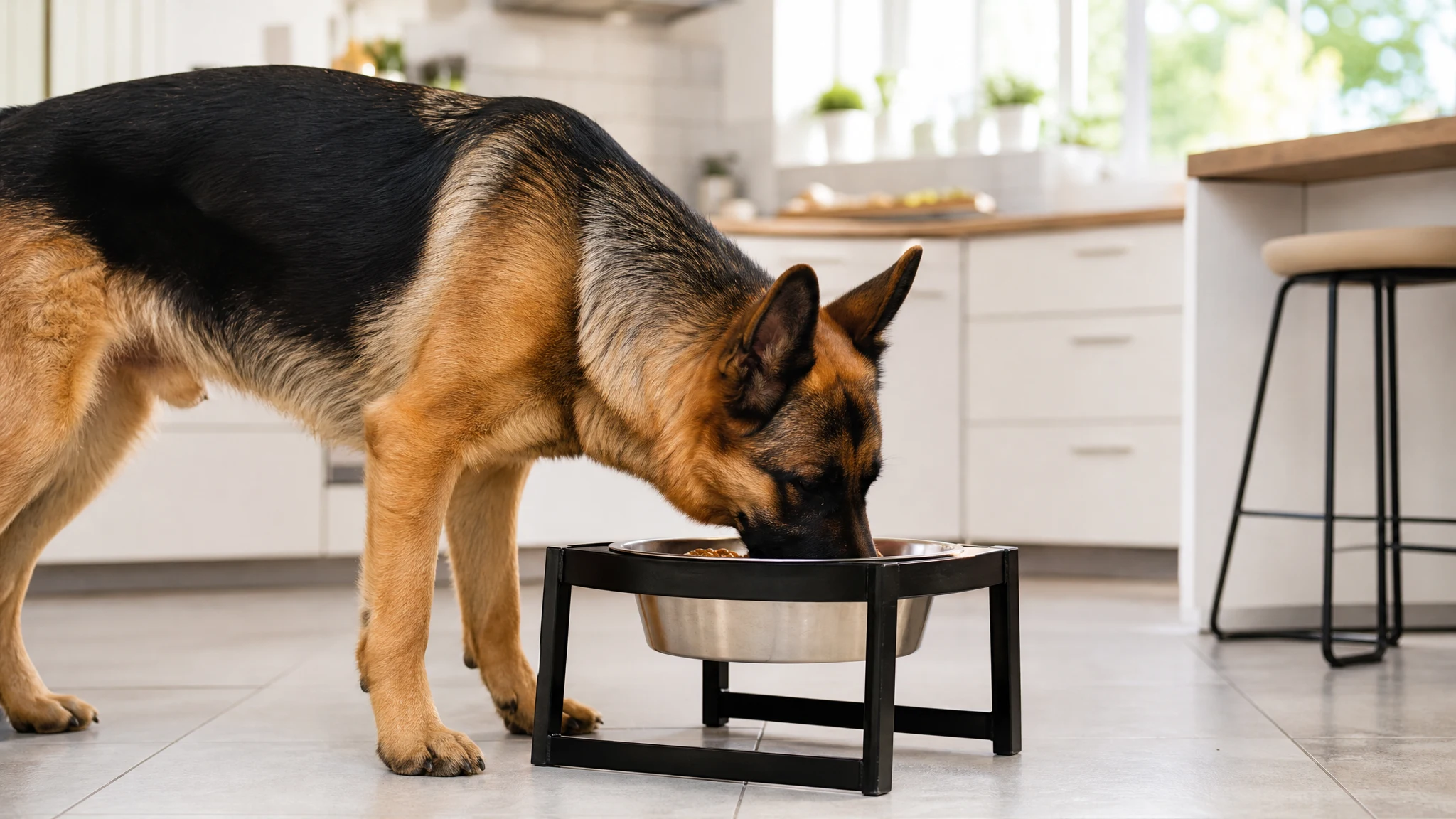
General nutrition information compiled from product labels and published sources, not veterinary advice. Your veterinarian is the right person to choose a diet for your dog, especially one with a health condition.
Picking the best food for German Shepherd life stages is only half the job. The other half is how much goes in the bowl, and that number should change as your dog grows, slows down or gets older.
This guide walks through a simple routine for adjusting portions. It uses label guides as starting points, a body check you can do at home, and a regular check-in with your veterinarian. For a broader age-by-age overview, see the German Shepherd feeding chart by age.
Why portions need to change
The AKC lists adult German Shepherd Dogs at 65 to 90 pounds for males and 50 to 70 pounds for females. A puppy has a long way to go to reach that size, and the pace matters.
Cornell University's Riney Canine Health Center says hip dysplasia is genetic but modified by nutrition and growth rate. It notes that overfeeding and rapid growth can worsen it in predisposed puppies. Cornell also says hip dysplasia is common in German Shepherds. That is why puppy portions deserve care, not just a full bowl.
Cornell's advice for large-breed puppies is to avoid overfeeding, use a diet formulated for large breeds while they grow, and not add calcium or vitamin D supplements to a growing puppy's diet. Its elbow dysplasia page adds that puppies at higher orthopedic risk should be kept trim while growing, without cutting essential nutrients.
What you need
- A complete and balanced food that suits your dog's life stage.
- A kitchen scale or a proper dry measuring cup.
- A notebook or phone note for weights and portions.
- The feeding guide printed on your food's bag or the brand's product page.
- Access to a scale for your dog, such as a vet clinic's walk-on scale.
- A slow-feeder or flat bowl, if your dog eats fast (more on this below).
Step 1: Match the food to the life stage
Start with the adequacy statement on the bag. For a growing German Shepherd, look for wording that says the food is formulated for growth including growth of large size dogs (70 lb. or more as an adult). Kentucky's rule 12 KAR 3:039, which uses the AAFCO model wording, says a food claiming growth or all life stages must carry either that phrase or the phrase "except for growth of large size dogs." Pick the first kind for a puppy.
Royal Canin's German Shepherd Puppy dry food carries the "including growth of large size dogs" wording. Royal Canin says it feeds this formula from 8 weeks to 15 months. It then moves to an adult formula from 15 months and a 5+ formula from 5 years. That is the manufacturer's own timeline, so ask your vet when your dog should switch.
Hill's lists its Science Diet Puppy Large Breed Chicken & Brown Rice Recipe for large-breed puppies up to 18 months. Its statement says the food is complete and balanced for growing puppies. It does not print the large-size phrase, so ask your vet if that matters for your dog.
We compared label data only. We did not run feeding trials or taste tests, and no food here is a guaranteed fit for every dog.
Step 2: Find the label starting amount
Every bag has a feeding guide. Treat it as a starting point, not a rule. Here are examples from the brands' own pages:
| Food | Label guide | Calories per cup |
|---|---|---|
| Royal Canin German Shepherd Puppy | 2 months, target adult weight 57 lb: 2 7/8 cups per day | 331 kcal ME |
| Royal Canin German Shepherd Adult | 2 to 4 equal portions per day | 338 kcal ME |
| Hill's Science Diet Adult Large Breed | 60 lb dog: 3 2/3 cups per day | 365 kcal |
| Royal Canin German Shepherd Adult 5+ | 57 lb dog: 3 1/4 cups (low activity), 4 1/4 (medium), 5 (high) | 321 kcal ME |
| Hill's Science Diet Adult 6+ Large Breed | 60 lb dog: 3 1/3 cups per day | 352 kcal |
Notice how much calories per cup vary. A cup of one food is not a cup of another. Whenever you change brands, re-read the new guide instead of copying the old scoop size.
Find your dog's current weight and, for a puppy, the expected adult weight on the chart. Where a guide lists activity levels, pick the one that honestly fits your dog.
Step 3: Weigh the food, not just the scoop
Scoops vary by how packed they are. If the label gives grams, as Royal Canin's and Hill's pages do, weigh the daily amount on a kitchen scale. Set the day's total aside each morning so treats and extras can come out of it.
Step 4: Split the day into two or more meals
Cornell's page on gastric dilatation volvulus (GDV, or bloat) lists feeding-related risk factors. These include a deep chest, eating too quickly, feeding once daily or in large meals, raised food bowls and exercise soon after eating. Cornell suggests two or more meals a day with smaller kibble. The AKC lists bloat among the health concerns for German Shepherds.
So divide the daily total into at least two meals. Royal Canin's adult guidance of 2 to 4 equal portions a day is in the same spirit. Keep the bowl at floor level, and give your dog a quiet rest after eating before any hard play. If your dog bolts food, ask your vet about slowing it down.
Step 5: Do a body check every two weeks
Scales alone do not tell the story. Check these things at home:
- Ribs: You should be able to feel them under a thin layer of padding without pressing hard.
- Waist: Look from above. There should be a visible tuck behind the ribs.
- Side view: The belly should rise slightly toward the back legs.
If ribs are hard to feel, trim the daily amount slightly. If they stand out sharply, increase it a little. Make small changes, around a tenth of the daily amount, and recheck in two weeks. Your vet can score your dog's body condition and tell you whether the number is right.
Step 6: Update the plan at each growth stage
- Young puppy (8 weeks to about 6 months): Three or four small meals are common. Keep to the large-breed growth food and the label guide for the expected adult weight.
- Adolescent (about 6 months to 15 months): Growth is still going on, but it is not an excuse to free-feed. Keep the body check going and shift to two meals.
- Adult (from about 15 months, per Royal Canin's timeline): Move to an adult formula gradually, mixing the new food with the old over about a week. Recalculate the portion from adult weight and activity.
- Senior (from about 5 or 6 years, per the brands' guidance): Activity often drops. Royal Canin's 5+ table shows a clear difference between low and high activity portions, so re-pick the activity level. The AKC gives a life expectancy of 12 to 14 years, so these years are a long chapter worth planning.
Tips
- Count treats and training rewards as food. Use a few pieces of the regular kibble when you can.
- Change only one thing at a time, either the food or the amount, so you can see what made the difference.
- Keep a log of weight and portions. Patterns show up that memory misses.
- Do not add calcium or vitamin D to a growing puppy, as Cornell advises. Ask your vet before any supplement at all.
Common mistakes
- Feeding to the "empty bowl" look. Puppies often act hungry no matter what. Judge by body condition.
- Using an adult formula too early or a puppy formula too long. Check the stage on the label and with your vet.
- Copying a scoop size across brands. Calories per cup differ, as the table shows.
- Heavy exercise right after meals. Cornell lists this among GDV risk factors.
- Assuming a grain-free or trendy label means better. The FDA says reports of diet-related dilated cardiomyopathy involve both grain-free and grain-containing diets, and that report counts alone do not establish cause. Talk it over with your vet instead of guessing.
What to expect
With steady, measured portions, many owners see a lean, active dog with steady energy and a healthy-looking coat. Results vary by dog, and portions alone cannot promise any outcome. Food does not prevent or treat hip dysplasia, elbow dysplasia, bloat or other conditions. Cornell says nutrition and growth rate can modify hip dysplasia risk in predisposed puppies, and that is the reason for careful growth.
If your dog has a health condition, such as digestive trouble, weight loss despite eating well, or joint problems, confirm amounts and the food itself with your vet first. Mississippi State University's veterinary college notes that German Shepherds are predisposed to exocrine pancreatic insufficiency, which causes poor digestion and weight loss. Only a veterinarian can diagnose it, and any prescription diet comes from a vet.
A note on the Royal Canin adult page
Royal Canin's German Shepherd Adult page prints an adequacy statement that names a different breed formula. That looks like a page error. Check the statement on the actual bag before you buy, and ask the brand if it is unclear.
Sources
- AKC: German Shepherd Dog breed page
- Cornell Riney Canine Health Center: Canine hip dysplasia
- Cornell Riney Canine Health Center: Elbow dysplasia
- Cornell Riney Canine Health Center: Gastric dilatation volvulus (GDV) or bloat
- Kentucky 12 KAR 3:039, Nutritional adequacy
- U.S. FDA: Questions and Answers on non-hereditary DCM in dogs
- Royal Canin: German Shepherd Puppy
- Royal Canin: German Shepherd Adult
- Royal Canin: German Shepherd Adult 5+
- Hill's: Science Diet Adult Large Breed
- Hill's: Science Diet Adult 6+ Large Breed
- Hill's: Science Diet Puppy Large Breed
- Mississippi State University College of Veterinary Medicine: Canine Exocrine Pancreatic Insufficiency