Dog Feeding Stations for German Shepherds: What to Look For
General nutrition information compiled from product labels and published sources, not veterinary advice. Your veterinarian is the right person to choose a diet for your dog, especially one with a health condition.
A dog feeding station is just the spot where your dog eats and drinks: bowls, a mat, maybe a stand or a slow feeder. For a German Shepherd, the details matter a little more than for a small dog. The breed is large and deep-chested, and bloat is a known concern for the breed according to the American Kennel Club (AKC).
This guide walks through how to build a simple setup, what to skip, and how to set meal times. It leans on what Cornell University's College of Veterinary Medicine says about feeding habits and bloat, plus label guidance from the food makers.
Why the Feeding Station Matters for This Breed
The AKC lists adult German Shepherd Dogs at 65 to 90 pounds for males and 50 to 70 pounds for females. Heights run 24 to 26 inches for males and 22 to 24 inches for females. That is a big dog with a deep chest.
Cornell's Riney Canine Health Center lists several feeding-related risk factors for gastric dilatation-volvulus (GDV, or bloat). They include large breed size, a deep chest, eating too quickly, one large meal a day, raised food bowls, and exercise soon after eating. Cornell suggests two or more meals a day, with smaller kibble.
None of this means a good setup will stop bloat. It means a station can be arranged to avoid the habits Cornell flags. A veterinarian decides what is right for an individual dog.
Materials You Will Need
- Food bowl: stainless steel or ceramic, wide and heavy enough not to slide or tip. Large enough for a full meal without spilling.
- Water bowl: a separate, larger bowl, cleaned daily.
- Non-slip mat: a washable mat that protects the floor and keeps bowls in place.
- Slow feeder or puzzle bowl (optional): only if your dog gulps food.
- Measuring cup or kitchen scale: so portions are the same each time.
- Airtight food container: to keep dry food in a spot away from the bowls.
- Timer or phone reminder: for meal times and the rest period afterward.
Step-by-Step: Setting Up the Station
Step 1: Pick a quiet, stable spot
Choose a place with a floor that is easy to clean and away from the front door and busy walkways. Dogs that feel rushed or watched tend to eat faster. A corner of the kitchen or a utility room often works.
If you have more than one pet, feed them in separate spots. Competition is a common reason dogs bolt their food.
Step 2: Keep the bowls at floor level
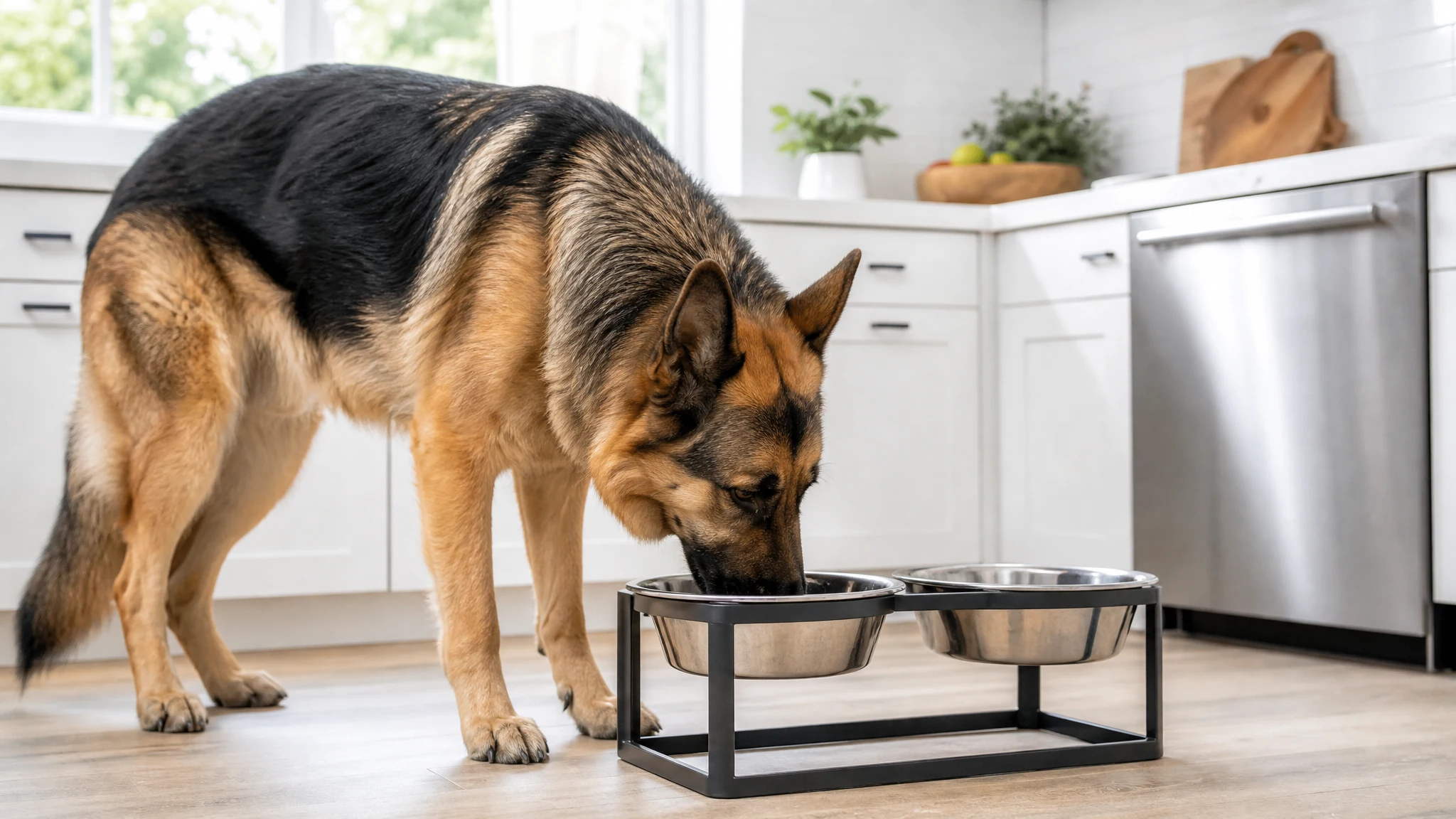
Raised feeders are sold as a comfort upgrade for big dogs. Cornell, however, lists raised food bowls among the feeding-related risk factors for GDV. Unless your veterinarian tells you otherwise for a specific reason, a floor-level or very low bowl is the more cautious choice.
If your dog has joint or neck trouble, ask your veterinarian before choosing a height, rather than guessing.
Step 3: Choose the bowl material and shape
Stainless steel and ceramic are easy to wash and do not hold odors the way scratched plastic can. A wide, shallow bowl is easier for a long muzzle than a narrow, deep one. Check the base: it should stay put when a 70-pound dog noses it around.
Step 4: Add the mat and place the water
Put the mat down first, then set the food bowl on it. Place the water bowl beside it, not on top of the food. Fresh water should be available all day. Wash both bowls daily with hot, soapy water.
Step 5: Decide whether a slow feeder is needed
Watch one or two meals. If the bowl is empty in under a minute and your dog is gulping, a slow feeder or puzzle bowl may help. Cornell names eating too quickly as a risk factor, so slowing a gulper is reasonable.
Pick one with ridges wide enough for a German Shepherd's muzzle. If your dog gets frustrated or starts chewing the bowl, switch back to a plain bowl and spread the meal across more feedings instead.
Step 6: Set meal times and amounts
Plan on two or more meals a day, as Cornell suggests, rather than one big meal. Use the food label as your starting point. Royal Canin's German Shepherd Adult page, for example, says to feed 2 to 4 equal portions a day. Its German Shepherd Adult 5+ feeding table lists a 57-pound dog at 3 1/4 cups a day with low activity, 4 1/4 cups with medium activity and 5 cups with high activity.
Hill's Science Diet Adult Large Breed lists 3 2/3 cups a day for a 60-pound dog. These numbers differ because the foods differ in calories, which is why you should read the guide on your own bag. Treat label amounts as a starting point, then adjust to your dog's body condition. For a broader breakdown by age, see our German Shepherd feeding chart by age.
If your dog has a health condition, confirm amounts and schedule with your veterinarian before changing anything.
Step 7: Build in a rest period
Cornell lists exercise soon after eating as a GDV risk factor. Keep the hour or so after meals calm. Plan walks and play before meals, not right after, and ask your veterinarian how long a wait suits your dog.
Step 8: Store food away from the station
Keep dry food in a sealed container in a cool, dry spot. Check the bag or the brand's page for storage directions. Fresh and refrigerated foods have their own rules. Hill's refrigerated roll, for example, must be kept below 40°F and not frozen, per its own page.
Puppies: Extra Things to Watch
Cornell's page on canine hip dysplasia says the condition is genetic but that nutrition and growth rate can modify it. It advises against overfeeding fast-growing large-breed puppies and against adding calcium or vitamin D supplements to a growing puppy's diet. It also recommends diets formulated for large breeds while puppies grow.
At the station, that means measuring every meal, even when a puppy begs. Check the adequacy statement on the bag. The AAFCO wording for a large-size growth food reads "including growth of large size dogs (70 lb. or more as an adult)," according to Kentucky's 12 KAR 3:039 rule, which uses the AAFCO model wording. Royal Canin's German Shepherd Puppy page carries that phrase. Check your own bag, or ask the brand or your veterinarian.
Tips for a Station That Works
- Feed at the same times each day so your dog settles into a routine.
- Pick up the bowl after the meal rather than leaving food out all day. It makes appetite changes easier to notice.
- Use smaller kibble if your dog bolts food. Cornell mentions smaller kibble as part of its advice.
- Wipe the mat and floor after each meal. German Shepherds drool and splash when drinking.
- If you switch foods, do it over several days and watch stool and appetite. Ask your veterinarian if you are unsure.
Common Mistakes to Avoid
- Buying a raised stand by default. Cornell lists raised bowls as a GDV risk factor, so do not assume taller is better.
- One big daily meal. Cornell flags large meals and once-daily feeding.
- Walking or playing right after dinner. Give your dog calm time first.
- Guessing portions. A scoop of unknown size can hide a large calorie difference.
- Using a scratched plastic bowl. It is harder to clean well.
- Treating a feeding tool as a treatment. A bowl or a food does not treat or cure hip dysplasia, bloat, allergies or digestive disease. Your veterinarian handles those.
What to Expect
A calm, consistent station may help your dog eat more slowly and keep mealtimes tidy. It may also make it easier to notice when appetite, drinking or stool changes. Results vary from dog to dog, and no setup can promise a particular health outcome.
Call your veterinarian promptly if your dog has a swollen or tight belly, repeated unproductive retching, restlessness or sudden distress. Those can be signs of an emergency. Also raise ongoing weight loss or poor digestion with your vet. The AKC and a Mississippi State University veterinary paper note that German Shepherds are predisposed to conditions such as exocrine pancreatic insufficiency.
How We Approached This Guide
We compared published guidance from veterinary schools and food-maker label data. We did not run feeding trials, taste tests or product tests. Food names above are examples drawn from the makers' own pages, not endorsements. Check each brand's page or your bag for current details.
Sources
- AKC: German Shepherd Dog breed page
- Cornell University College of Veterinary Medicine: Gastric dilatation volvulus (GDV) or bloat
- Cornell University College of Veterinary Medicine: Canine hip dysplasia (CHD)
- Kentucky Agricultural Experiment Station: 12 KAR 3:039, Nutritional adequacy
- Royal Canin: German Shepherd Adult Dry Dog Food
- Royal Canin: German Shepherd Adult 5+ Dry Dog Food
- Royal Canin: German Shepherd Puppy Dry Dog Food
- Hill's Science Diet: Adult Large Breed Chicken & Barley Recipe
- Hill's Science Diet: Adult Single Protein Chicken & Brown Rice Fresh Dog Food Roll
- Mississippi State University College of Veterinary Medicine: Canine Exocrine Pancreatic Insufficiency