Elevated vs Standard Feeding Stations: Which Is Right for a German Shepherd
General nutrition information compiled from product labels and published sources, not veterinary advice. Your veterinarian is the right person to choose a diet for your dog, especially one with a health condition.
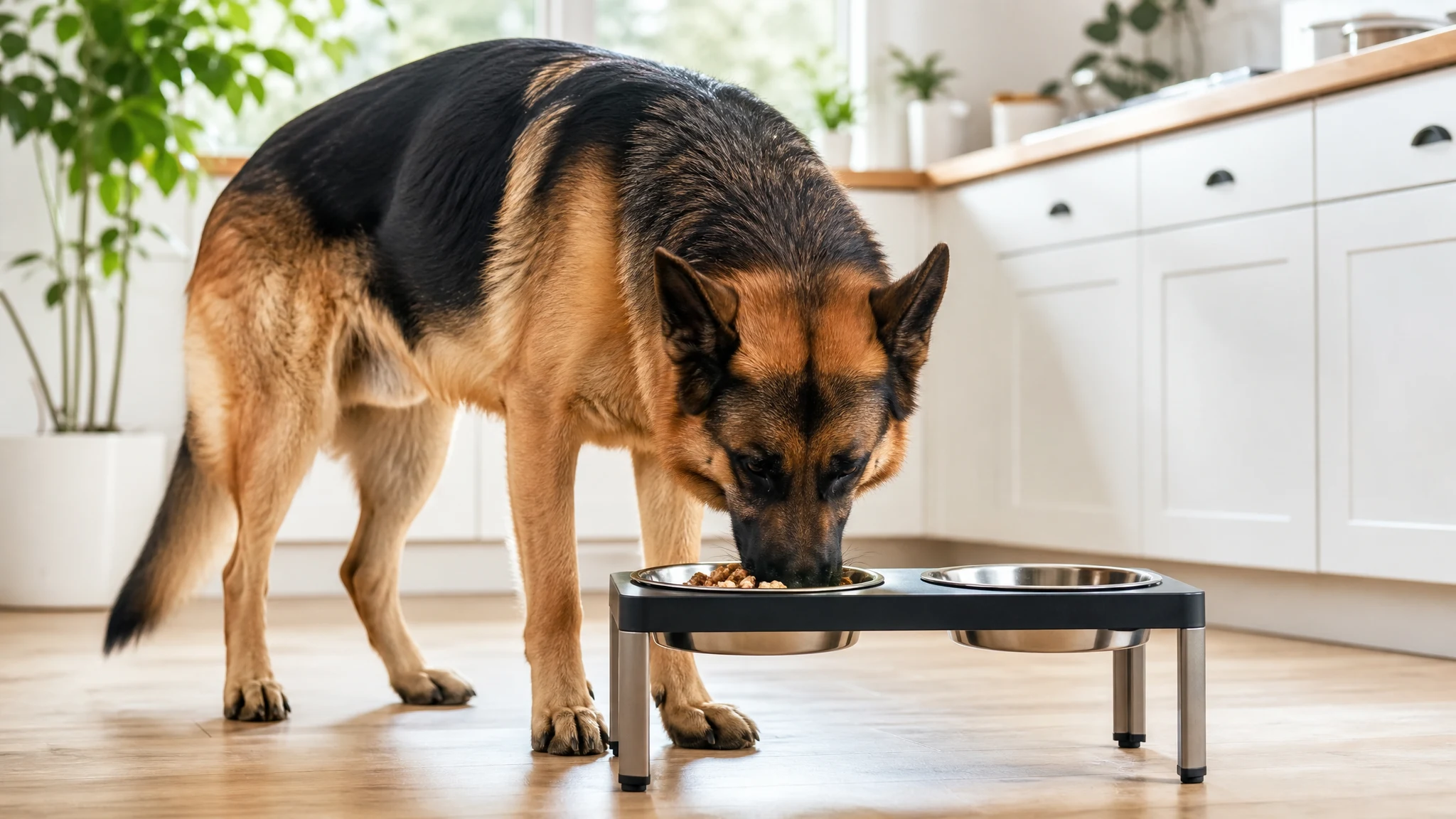
Raised bowls look tidy and seem kind to a big dog's neck. But for a German Shepherd, the choice is not as simple as taller equals better.
This guide walks you through setting up a dog feeding station, comparing the elevated and standard options, and watching how your dog does. We did not test any stands or bowls ourselves. What follows is based on published veterinary and breed sources.
The short answer
Cornell University College of Veterinary Medicine's Riney Canine Health Center lists raised food bowls among the feeding-related risk factors for gastric dilatation-volvulus (GDV), also called bloat. The other factors on its list are large breed size, a deep chest, eating too quickly, feeding once daily or in large meals, and exercise soon after eating.
The AKC breed page for the German Shepherd Dog names bloat as a health concern for the breed. Cornell's list is about risk factors, not a promise about any one dog. Still, it gives a careful reader a reason to start with a standard, floor-level setup unless a veterinarian suggests otherwise.
No feeding station prevents bloat. A veterinarian decides what suits an individual dog, especially one with neck, back, joint or digestive problems.
Standard vs elevated: how they compare
| Point | Standard (floor level) | Elevated (raised stand) |
|---|---|---|
| Bloat guidance | Not on Cornell's list of risk factors | Raised bowls are on Cornell's list of GDV risk factors |
| Cost and setup | Just a bowl and a mat | Needs a stand sized to your dog |
| Fit for a growing puppy | Easy to keep at the right height | Height must be changed as the puppy grows |
| Mobility concerns | May feel like a reach for a stiff older dog | Some owners find it more comfortable; ask your vet first |
The table shows why the question is a trade-off. If your dog has a mobility issue, comfort may matter. If your dog is healthy, the published risk factors point toward the simpler option.
Materials you will need
- A bowl wide and shallow enough for your dog's long muzzle, in stainless steel, ceramic or another easy-to-clean material.
- A non-slip mat to catch spills and stop the bowl from sliding.
- A measuring cup, or a kitchen scale if your food's label gives weights.
- The feeding guide printed on your dog's food bag or the brand's product page.
- Optional: a slow-feeder insert or a lick-style mat, if your dog eats very fast.
- Optional: a raised stand, only if your veterinarian recommends one.
Step-by-step: set up the feeding station
1. Pick a calm, quiet spot
Choose a low-traffic corner of the kitchen or utility room. A dog that feels rushed or watched tends to gulp. Eating too quickly is another item on Cornell's GDV risk list, so a peaceful spot helps.
2. Start at floor level
Place the bowl on the mat on the floor. This is the standard setup and the one that avoids the raised-bowl factor Cornell mentions. Keep it away from stairs and slippery tile.
3. Choose the right bowl shape
A German Shepherd has a long muzzle. Royal Canin designs its German Shepherd adult kibble around that long, strong muzzle, which hints at how the breed eats. Pick a bowl that is wide enough that your dog does not have to push food into a corner.
Avoid very deep, narrow bowls. They make it hard to reach the last pieces and can push a dog to tilt or gulp.
4. Decide on the meal schedule
Cornell suggests two or more meals a day, rather than one large meal, for dogs at risk of GDV. Royal Canin's German Shepherd adult page likewise recommends 2 to 4 equal portions per day. Splitting the daily amount into two or three meals fits both.
Feed at the same times each day so the routine becomes predictable.
5. Measure the portion
Use the label's feeding guide as a starting point, not a fixed rule. Amounts depend on your dog's age, weight and activity level. For example, Royal Canin's German Shepherd 5+ table lists 3 1/4 cups a day for a 57 lb dog with low activity, and 5 cups for high activity. That is a big spread, which shows why activity matters.
For a full breakdown, see our German Shepherd feeding chart by age.
Divide the daily total by the number of meals, then measure each one. If your dog has a health condition, confirm the amounts with your veterinarian before you settle on them.
6. Control the pace
If your dog finishes in under a minute, try a slow-feeder insert, or scatter the kibble over a lick-style mat. Some brands, such as Royal Canin, describe kibble shapes made to encourage chewing. Check the brand's own page for what its kibble is designed to do.
7. Keep exercise away from mealtime
Cornell lists exercise soon after eating as a GDV risk factor. Let your dog rest quietly after meals. Ask your veterinarian how long to wait, since we have no firm number to give you.
8. Consider an elevated stand only with a reason
If your veterinarian suggests a raised bowl, for example because of neck or joint discomfort, ask them to explain how high it should be and whether any bloat precautions apply. Do not buy a stand just because it looks like a premium upgrade.
9. Clean the station daily
Wash the bowl and wipe the mat each day. Leftover food and saliva build up quickly, and a dirty bowl can put a dog off eating.
Special cases: puppies and older dogs
Puppies grow quickly. Cornell's hip dysplasia page advises against overfeeding fast-growing large-breed puppies and says to feed a diet formulated for large breeds while they grow. It also advises against adding calcium or vitamin D to a growing puppy's diet.
The AKC lists adult males at 65 to 90 pounds and females at 50 to 70 pounds. That puts many German Shepherds near the 70 lb line AAFCO uses for large-size growth. Look for a puppy food whose label says it covers "growth of large size dogs (70 lb. or more as an adult)." Royal Canin's German Shepherd Puppy label carries that wording. Check the bag in front of you.
Royal Canin lists its puppy formula from 8 weeks to 15 months, its adult formula from 15 months and its 5+ formula from 5 years. This is manufacturer guidance, so treat the ages as a guide and ask your veterinarian when to switch.
For a puppy, a floor-level bowl needs no adjusting as your dog grows. For a senior dog with sore joints, talk to your veterinarian before changing the height of the bowl.
Tips
- Watch how your dog eats for a week. Note speed, posture and anything unusual afterwards.
- Keep one feeding spot so your dog knows where to go.
- Feed multiple dogs in separate spots so none gulps to protect its food.
- Measure every meal. Eyeballing leads to drift in portions over time.
- Change foods gradually and ask your veterinarian how.
Common mistakes to avoid
- Buying a raised stand by default. Cornell lists raised bowls as a GDV risk factor, so make it a decision with a reason.
- One large meal a day. Cornell lists this as a risk factor as well.
- Letting a dog gulp. A bowl that is too deep, or competition at mealtime, speeds eating up.
- Playing hard right after dinner. Keep the dog quiet.
- Treating the label as exact. Feeding guides are starting points. Adjust with your veterinarian's help if your dog gains or loses weight.
- Adding supplements without advice. Ask your veterinarian first, particularly for a growing puppy.
What to expect
A calm, consistent station may help your dog eat more slowly and settle after meals. Results vary from dog to dog, and no setup can promise that bloat will not occur.
Within a couple of weeks you may notice a steadier routine, less spilling and a more even pace at the bowl. If your dog suddenly retches without producing anything, has a swollen belly or seems restless and distressed, treat it as an emergency and call a veterinarian immediately. Cornell describes bloat as a serious condition.
Persistent weight loss or poor digestion is also a reason to see your veterinarian. The Mississippi State University College of Veterinary Medicine notes that German Shepherds are predisposed to exocrine pancreatic insufficiency, and only a veterinarian can sort out what is going on.
How this guide was put together
We compared published veterinary guidance and manufacturer label data. We did not run feeding trials, taste tests or product tests of bowls and stands.
Sources
- Cornell University College of Veterinary Medicine, Riney Canine Health Center: Gastric dilatation volvulus (GDV) or bloat
- Cornell University College of Veterinary Medicine, Riney Canine Health Center: Canine hip dysplasia (CHD)
- American Kennel Club: German Shepherd Dog breed page
- Royal Canin US: German Shepherd Adult Dry Dog Food
- Royal Canin US: German Shepherd Puppy Dry Dog Food
- Royal Canin US: German Shepherd Adult 5+ Dry Dog Food
- Mississippi State University College of Veterinary Medicine: Enzymes gone AWOL: Canine Exocrine Pancreatic Insufficiency
- Kentucky Agricultural Experiment Station, 12 KAR 3:039 Nutritional adequacy (AAFCO model wording for large-size growth)