Food for German Shepherd Puppy: A Feeding Routine for the First Year
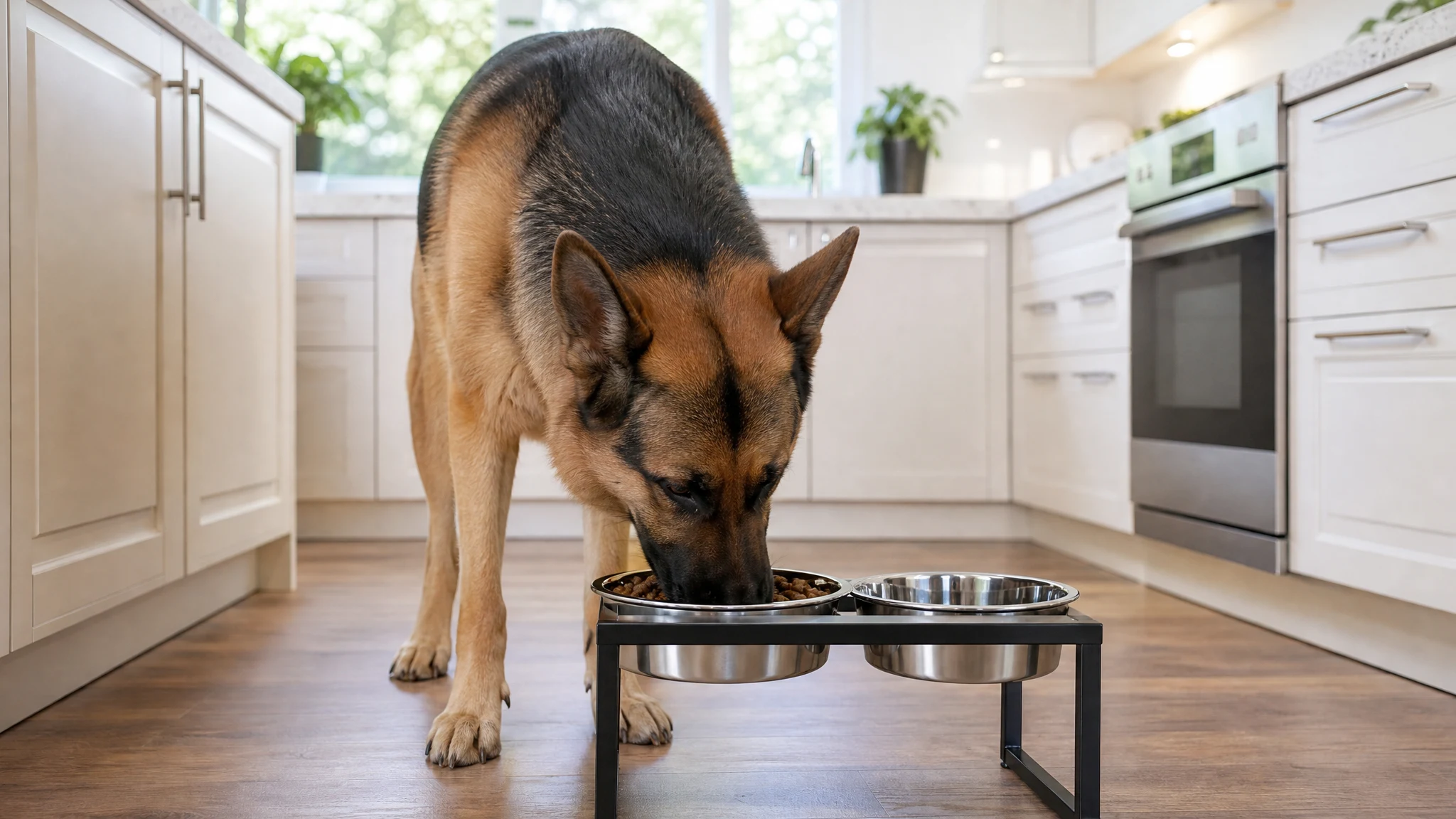
General nutrition information compiled from product labels and published sources, not veterinary advice. Your veterinarian is the right person to choose a diet for your dog, especially one with a health condition.
A German Shepherd puppy grows fast, and the bag you pick shapes that growth. This guide walks through a simple first-year routine: what to gather, how to read the label, how to set up meals and how to adjust as your puppy grows.
The advice here comes from veterinary school pages, the breed club and manufacturer label data. We compared label data only. We did not run feeding trials or taste tests, and we did not feed any of these foods ourselves.
What You Need
- A complete and balanced puppy food whose label names large-size growth (more on this below).
- A dry measuring cup or a kitchen scale, so you feed by measure instead of by eye.
- A slow-feeder or a plain, floor-level bowl.
- A notebook or phone note for weight, meals and stool quality.
- Your veterinarian's contact details, since they decide amounts for an individual dog.
Step 1: Know Your Puppy's Likely Adult Size
The AKC breed page lists adult males at 65 to 90 pounds and females at 50 to 70 pounds. That puts many German Shepherds at or near the 70 pound line that pet food labels use for large-size dogs.
Royal Canin calls its German Shepherd puppy food a large breed growth formula, which fits. Your puppy's own adult weight will vary, so treat these ranges as a guide and not a promise.
Step 2: Choose a Food Labeled for Large-Size Growth
Look for the adequacy statement, usually near the guaranteed analysis. Under the AAFCO model wording, as reflected in Kentucky's rule 12 KAR 3:039, a food that claims "growth" or "all life stages" must add one of two phrases. One says the food is for "growth including growth of large size dogs (70 lb. or more as an adult)." The other says "except for growth of large size dogs (70 lb. or more as an adult)."
For a German Shepherd puppy, the "including" version is the one to look for. Cornell's Riney Canine Health Center also advises feeding diets formulated for large breeds while puppies grow.
Here is how a few foods compare on label data. We did not test any of them.
| Food | What the label data says |
|---|---|
| Royal Canin Breed Health Nutrition German Shepherd Puppy (dry) | Statement includes growth of large size dogs. Fed from 8 weeks to 15 months. Minimum protein 28%, minimum fat 14%. 331 kcal ME per cup. First ingredients: chicken by-product meal, corn, wheat gluten, oat groats, brewers rice. |
| Hill's Science Diet Puppy Large Breed Chicken & Brown Rice (dry) | Statement says it is complete and balanced for growing puppies, backed by feeding tests, with no large-size phrase. Hill's labels it for large breed puppies up to 18 months. Hill's lists average dry-matter protein of 26.3% and fat of 15.4%, not label minimums. 391 kcal per cup. |
| JustFoodForDogs Chicken & Rice Recipe (fresh frozen) | Statement covers all life stages, including growth of large size dogs. Guaranteed analysis is as fed: minimum protein 8%, minimum fat 3%, with moisture up to 72%. |
Do not compare the fresh food's 8% protein directly with the dry foods' figures. Moisture changes the numbers, so as-fed percentages are not like for like.
Note the Hill's difference. Its statement lacks the large-size phrase, so ask your veterinarian whether it suits your puppy, or check the bag.
Step 3: Set a Starting Amount From the Label
Use the feeding table on the bag as a starting point, matched to your puppy's age and expected adult weight. As one example, Royal Canin's table for its puppy food lists 2 7/8 cups (262 g) per day for a 2 month old puppy with a target adult weight of 57 pounds. That is one brand's figure for one case, not a rule for every puppy.
Calories differ between foods, so never swap a different food in at the same cup count. For adult dogs, Royal Canin's German Shepherd adult label suggests 2 to 4 equal portions per day. For a rough sense of how amounts change over time, see our German Shepherd feeding chart by age.
Step 4: Split the Day Into Smaller Meals
Cornell's page on gastric dilatation volvulus (bloat) lists feeding risk factors. They include large breed size, a deep chest, eating too quickly, feeding once daily or in large meals, raised food bowls and exercise soon after eating. The AKC names bloat among the health concerns for German Shepherds.
Cornell suggests two or more meals a day, with smaller kibble. Practical ways to apply that:
- Divide the daily amount into at least two meals.
- Serve at roughly the same times each day.
- Use a floor-level bowl or a slow feeder if your puppy gulps.
- Keep play calm for a while after meals.
This is about lowering known risk factors, not preventing bloat. Ask your veterinarian how many meals suit your puppy's age.
Step 5: Aim for Steady Growth, Not Fast Growth
Cornell's hip dysplasia page says the condition is genetic but modified by nutrition and growth rate. Overfeeding and rapid growth can worsen it in predisposed puppies. Cornell advises avoiding overfeeding fast-growing large-breed puppies. For puppies at higher orthopedic risk, it says to keep them trim while they grow, without cutting essential nutrients.
So a chubby puppy is not a healthy puppy. Weigh your puppy on a schedule your veterinarian suggests. Feel the ribs: you should be able to feel them under a thin layer of padding. If the weight climbs faster than your vet expects, ask about reducing the portion.
Step 6: Skip Extra Calcium and Vitamin D
Cornell advises not supplementing growing puppies with calcium or vitamin D. A complete large-breed puppy food is already formulated for growth. Adding supplements on top can upset that balance. If you are thinking about any supplement, ask your veterinarian first.
Step 7: Change Foods Gradually and Watch the Stool
When you switch foods, mix the new food into the old over several days, increasing the new share a little at a time. The exact pace is a judgment call, so follow the brand's guidance or your vet's advice.
Keep notes on appetite and stool. Ongoing loose stool or weight loss despite a good appetite deserves a vet visit. The Mississippi State University College of Veterinary Medicine conference paper on exocrine pancreatic insufficiency notes German Shepherds are predisposed to it. No food treats that condition, and only a veterinarian can diagnose it.
Step 8: Plan the Move to an Adult Food
Brands set their own switch ages. Royal Canin feeds its German Shepherd puppy formula from 8 weeks to 15 months, then moves to its adult formula. Hill's large breed puppy food runs up to 18 months. We found no vet-school or parent club age, so ask your veterinarian when your puppy is ready. Make the change gradually, as in Step 7.
Common Mistakes to Avoid
- Feeding an adult food to a growing puppy. Check the statement for growth and the large-size phrase.
- Free-feeding. An always-full bowl makes it hard to track intake and weight.
- Trusting the bag amount forever. The table is a starting point. Adjust with your puppy's body condition and your vet's advice.
- Adding calcium or vitamin D. Cornell advises against it for growing puppies.
- Choosing by marketing. Words like "natural" or "premium" say little. The adequacy statement and ingredient list say more.
- Hard exercise right after meals. Cornell lists it as a bloat risk factor.
A Note on Grain-Free Diets and DCM
You may see worries about grain-free foods and a heart condition called dilated cardiomyopathy (DCM). The FDA says it received 1,382 reports of DCM in dogs from January 1, 2014 to November 1, 2022. It also says report counts alone do not establish a causal relationship.
The reports involve both grain-free and grain-containing diets. The FDA has not requested recalls. All the puppy foods in the table above contain grains or grain-based ingredients. If you are weighing a different diet, talk to your veterinarian.
What to Expect
With a suitable large-breed puppy food, measured meals and regular weigh-ins, many owners find their puppy gains weight steadily and keeps a lean, athletic shape. Stools often become consistent once the diet settles. Results vary by puppy, and no food guarantees a particular outcome, including for hips, elbows or digestion.
If your puppy has a health condition, confirm all amounts and food choices with your veterinarian. Prescription diets are only something a veterinarian prescribes.
Sources
- AKC, German Shepherd Dog breed page
- Cornell University College of Veterinary Medicine, Canine hip dysplasia (CHD)
- Cornell University College of Veterinary Medicine, Gastric dilatation volvulus (GDV) or bloat
- Kentucky Agricultural Experiment Station, 12 KAR 3:039 Nutritional adequacy
- U.S. FDA, Questions & Answers: FDA's Work on Potential Causes of Non-Hereditary DCM in Dogs
- Mississippi State University College of Veterinary Medicine, Enzymes gone AWOL: Canine Exocrine Pancreatic Insufficiency
- Royal Canin US, German Shepherd Puppy Dry Dog Food
- Hill's Pet, Science Diet Puppy Large Breed Chicken & Brown Rice Recipe
- JustFoodForDogs, Chicken & Rice Recipe