German Shepherd Feeding Chart by Age: Cups Per Day by Weight
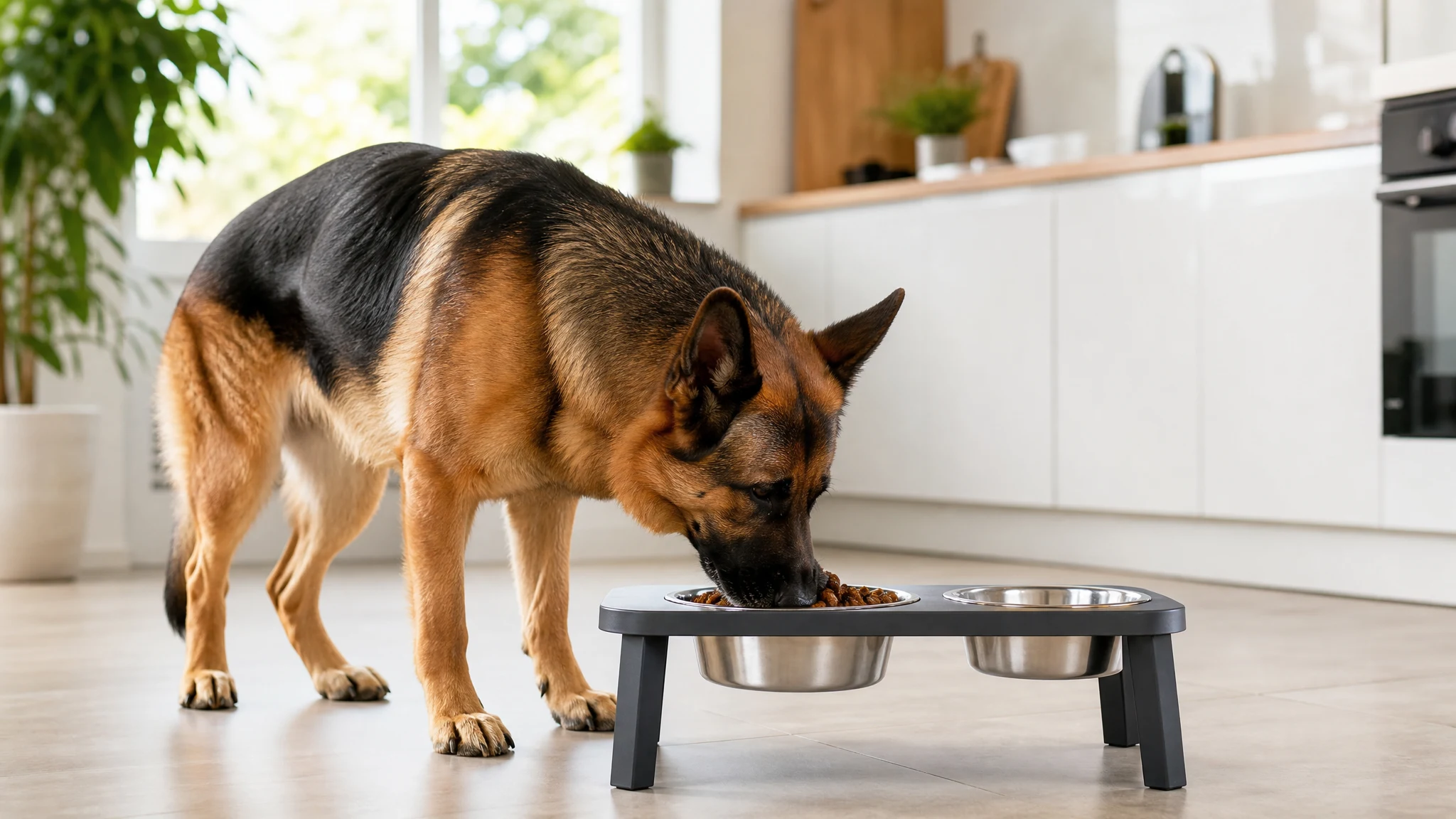
General nutrition information compiled from product labels and published sources, not veterinary advice. Your veterinarian is the right person to choose a diet for your dog, especially one with a health condition.
Every bag of dog food prints a feeding guide, and every guide is a little different. A German Shepherd's right amount depends on age, adult weight, activity and the calories in that specific food. This article shows how to build your own german shepherd feeding chart by age from the label, then adjust it by watching your dog.
We compared label data only. We did not run feeding trials or taste tests, and we have not fed these foods ourselves. Treat every number below as a starting point.
What size is a German Shepherd, and why it matters for the chart
The AKC breed page lists adult males at 65 to 90 pounds and females at 50 to 70 pounds. Life expectancy is listed at 12 to 14 years. That range puts many German Shepherds right around the 70 pound line that AAFCO uses for large-size dogs.
Because feeding tables are built around target adult weight, you need a rough idea of where your dog will end up. Ask your breeder or veterinarian for an estimate.
Materials you need
- The bag or can your dog eats now, with the label and feeding table in view.
- A standard 8 ounce measuring cup, or a kitchen scale for weighing portions.
- A bathroom or pet scale to record your dog's weight.
- A notebook or phone note for a simple weekly log.
- A slow-feeder or plain bowl, set at floor level.
Step 1: Pick a food that matches the life stage
Check the AAFCO statement on the label. For puppies, the statement should say the food is formulated for growth. The AAFCO wording, as reproduced in Kentucky's 12 KAR 3:039 rule, adds either "including growth of large size dogs (70 lb. or more as an adult)" or "except for growth of large size dogs (70 lb. or more as an adult)." For a German Shepherd puppy, look for the "including" version.
Royal Canin's German Shepherd Puppy label carries the "including growth of large size dogs" wording. The Royal Canin German Shepherd Puppy page gives 331 kcal ME per cup and a feeding range of 8 weeks to 15 months. Hill's labels its Science Diet Puppy Large Breed for puppies over 55 pounds as adults, up to 18 months. Its statement says the food is complete and balanced for growing puppies and does not include the large-size phrase, so ask your veterinarian whether it suits your puppy.
Step 2: Find the calories per cup
Two foods can have very different calories in the same cup. Here is what the brands publish:
| Food (dry) | Stage | Calories per cup |
|---|---|---|
| Royal Canin German Shepherd Puppy | 8 weeks to 15 months | 331 kcal ME |
| Royal Canin German Shepherd Adult | Over 15 months | 338 kcal ME |
| Royal Canin German Shepherd Adult 5+ | 5 years and older | 321 kcal ME |
| Hill's Science Diet Puppy Large Breed Chicken & Brown Rice | Up to 18 months | 391 kcal |
| Hill's Science Diet Adult Large Breed Chicken & Barley | 1 to 5 years | 365 kcal |
| Hill's Science Diet Adult 6+ Large Breed Chicken Meal, Barley & Rice | 6 years and older | 352 kcal |
If you switch brands, the cup count must change too. Do not carry a number from one bag to another.
Step 3: Read the feeding table for your dog's weight
Feeding tables list weight on one side and cups per day on the other. Find your dog's current weight for adults, or the projected adult weight for puppies, and read across.
A few real label examples show how much the tables vary:
- Royal Canin German Shepherd Puppy: at 2 months, with a target adult weight of 57 pounds, the table says 2 7/8 cups (262 g) per day.
- Hill's Science Diet Adult Large Breed: for a 60 pound dog, 3 2/3 cups (365 g) per day.
- Hill's Science Diet Adult 6+ Large Breed: for a 60 pound dog, 3 1/3 cups (330 g) per day.
- Royal Canin German Shepherd Adult 5+: for a 57 pound dog, 3 1/4 cups (279 g) at low activity, 4 1/4 cups (367 g) at medium and 5 cups (426 g) at high.
Notice how activity level changes the Royal Canin 5+ amount by almost two cups. A couch-loving senior and a dog who herds, hikes or trains daily should not get the same scoop. For other weights and ages, read the table on your own bag or the brand's page, since we only have the examples above. Our full guide to how much to feed a German Shepherd by age goes deeper on this.
Step 4: Split the day's amount into meals
Cornell University's Riney Canine Health Center lists feeding once daily or in large meals as a risk factor for bloat (gastric dilatation-volvulus), along with eating too quickly, raised food bowls and exercise soon after eating. It suggests two or more meals a day, with smaller kibble. The AKC also names bloat among the health topics for the breed.
For Royal Canin's adult formula, the brand's guide recommends 2 to 4 equal portions a day. Divide the daily total evenly, and measure each portion rather than eyeballing it.
Practical habits that follow from this:
- Feed at least two meals a day.
- Use a bowl at floor level, not a raised stand.
- Keep hard exercise away from mealtime.
- Slow down fast eaters with a slow-feeder bowl.
Bloat is an emergency. If your dog has a swollen belly, retching with nothing coming up, or restlessness, call a veterinarian right away.
Step 5: Adjust the amount for puppies carefully
Cornell's hip dysplasia page says the condition is genetic, but nutrition and growth rate can modify it. It advises avoiding overfeeding fast-growing large-breed puppies, using a diet made for large breeds while they grow, and not adding calcium or vitamin D to a growing puppy's diet. Its elbow dysplasia page adds that puppies at higher orthopedic risk should be kept trim while growing, without cutting essential nutrients.
In practice, that means measuring, not free-feeding, and checking body condition often. A lean, steadily growing puppy is the goal, not the biggest puppy in the class. Your veterinarian can tell you whether your puppy's growth curve looks right.
Step 6: Change foods by life stage, slowly
Royal Canin moves its German Shepherd line from the puppy formula to the adult formula at 15 months and to the 5+ formula at 5 years. Hill's uses 18 months for large-breed puppies, 1 to 5 years for adult large breed, and 6 and older for its senior large-breed recipe. These are manufacturer guides, and we found no age set by a vet school or the breed's parent club. Ask your veterinarian when to switch your own dog.
When you do switch, mix the new food into the old one over about a week, shifting the ratio a little each day. Watch the stool and appetite. Recalculate cups at the same time, since calories per cup change between formulas.
Step 7: Weigh, check and adjust every few weeks
The label gives you a starting amount. Your dog's body tells you whether it is right. Each week, record weight and note how the ribs feel under your hands and whether there is a visible waist from above. If your dog is gaining too fast or losing weight, adjust by a small amount and recheck in two weeks. Ask your veterinarian what a healthy body condition looks like for your dog.
Tips and common mistakes
- Using a coffee mug as a scoop. Mugs vary a lot. Use a real measuring cup or a scale.
- Ignoring treats. Treats and training rewards count toward the day's calories. Take them from the meal portions.
- Feeding by the bag's top weight. Use your dog's actual weight, or projected adult weight for a puppy.
- Adding calcium or vitamin supplements to a puppy. Cornell advises against it for growing puppies. Talk to your veterinarian before adding any supplement.
- Switching foods all at once. Abrupt changes can upset digestion.
- Treating a label like a prescription. It is a guide for the average dog, not yours.
- Trusting grain-free marketing. The FDA's investigation into canine dilated cardiomyopathy (DCM) has involved reports on both grain-free and grain-containing diets, and the FDA says report counts alone do not establish a causal relationship. The FDA has not requested recalls. Ask your veterinarian about any concerns.
If your dog has a health condition
German Shepherds are discussed in connection with hip and elbow dysplasia, degenerative myelopathy and exocrine pancreatic insufficiency (EPI), according to the AKC, Cornell and Mississippi State's veterinary college. No over-the-counter food treats these conditions, and the amounts in this article are not tuned for them. If your dog has a diagnosed condition, is losing weight, or has ongoing stomach trouble, confirm the amount and the food with your veterinarian. Prescription diets are something only a veterinarian prescribes.
What to expect
If you measure meals, split them through the day and weigh your dog regularly, you may see steadier weight, more consistent stools and fewer guesses about how much to scoop. A puppy fed a large-breed growth formula in measured amounts may grow at a more even pace. Results vary from dog to dog, and no feeding plan can promise a particular outcome or prevent a particular illness.
Quick recap
- Choose a food that fits your dog's life stage, with the large-size growth wording for puppies.
- Note the calories per cup.
- Read the table for your dog's weight and activity.
- Split the amount into two or more measured meals.
- Keep puppies lean and growing steadily.
- Change foods at the label's age guide, slowly, with your vet's input.
- Weigh and adjust every few weeks.
Sources
- AKC breed page, German Shepherd Dog
- Cornell University College of Veterinary Medicine, Gastric dilatation volvulus (GDV) or bloat
- Cornell University College of Veterinary Medicine, Canine hip dysplasia (CHD)
- Cornell University College of Veterinary Medicine, Elbow dysplasia
- Kentucky Agricultural Experiment Station, 12 KAR 3:039 Nutritional adequacy
- U.S. FDA, Questions and Answers on non-hereditary DCM in dogs
- Royal Canin, German Shepherd Puppy
- Royal Canin, German Shepherd Adult
- Royal Canin, German Shepherd Adult 5+
- Hill's Science Diet, Puppy Large Breed
- Hill's Science Diet, Adult Large Breed
- Hill's Science Diet, Adult 6+ Large Breed