German Shepherd Puppy Food: How Much to Feed by Week
General nutrition information compiled from product labels and published sources, not veterinary advice. Your veterinarian is the right person to choose a diet for your dog, especially one with a health condition.
Every owner of a new German Shepherd puppy asks the same thing: how many cups, and how often? The honest answer is that no single number fits every puppy. The right amount depends on the food's calories, the puppy's age, the adult size the puppy is headed for, and how active the puppy is.
This guide shows how to work out a starting amount from the feeding guide on the bag, how to split it into meals, and how to adjust it as your puppy grows. Choosing german shepherd puppy food is only half the job. Measuring it well is the other half.
What You Need
- A large-breed puppy food with its feeding guide (the bag or the brand's own product page).
- A dry measuring cup, or better, a kitchen scale that reads in grams.
- A notebook or phone note for weights, amounts and stool quality.
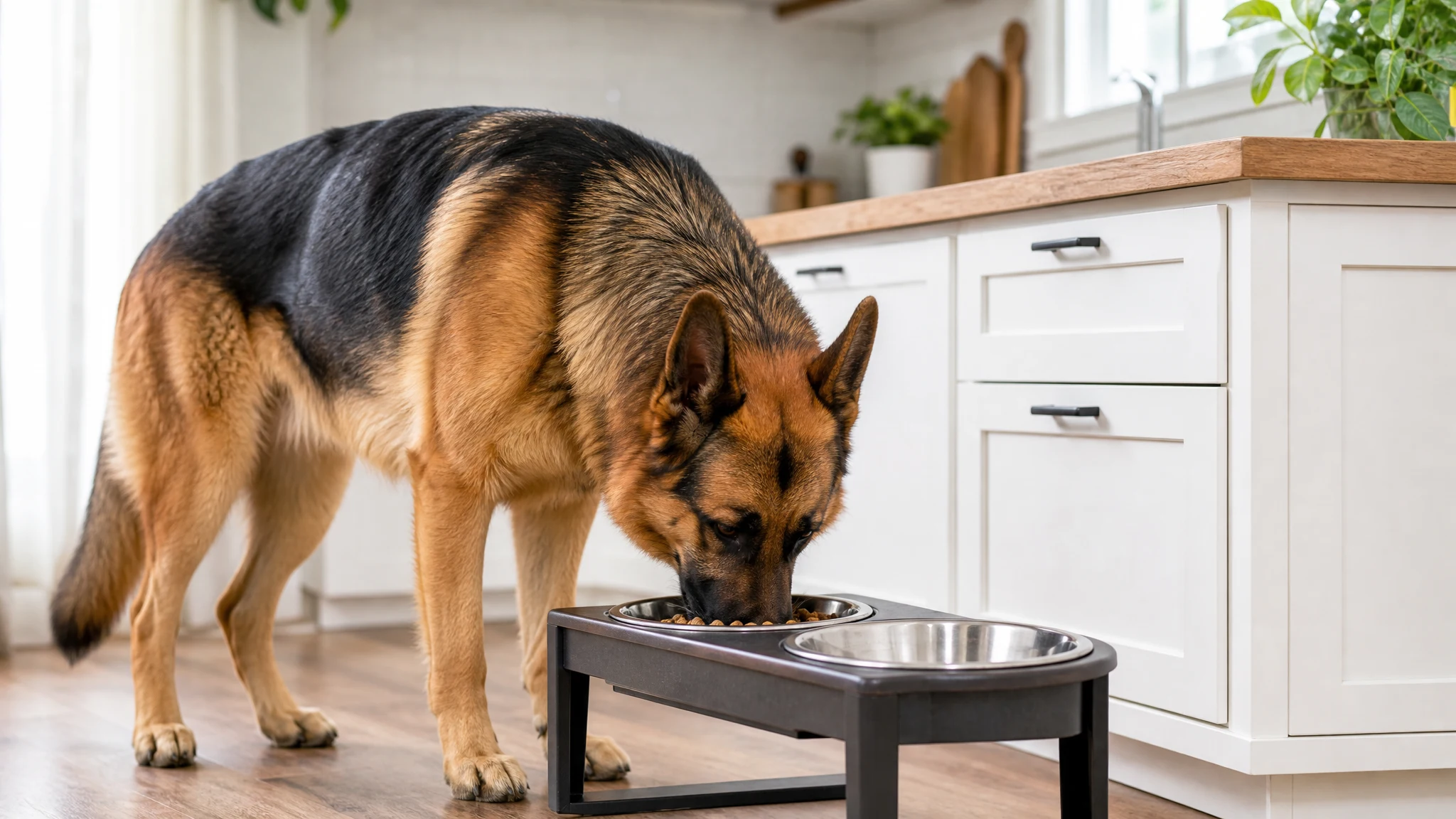
- A floor-level bowl. Cornell University's Riney Canine Health Center lists raised food bowls among the feeding-related risk factors for bloat.
- Your veterinarian's contact details, for weigh-ins and questions.
How We Compared Foods
We compared label data: adequacy statements, ingredients, calories and published nutrient numbers. We did not run feeding trials or taste tests, and we did not feed any of these foods to dogs. The comparison below shows what the labels say. It does not say how a given puppy will do on a food.
Step 1: Know the Size Your Puppy Is Heading For
The American Kennel Club (AKC) breed page lists adult German Shepherd Dogs at 65 to 90 pounds for males and 50 to 70 pounds for females. That puts most of them near or above the 70 pound line that pet food rules use to define a large-size dog.
This matters because feeding guides are built around target adult weight. Ask the breeder or your veterinarian for a realistic adult weight for your puppy, then use that column of the chart.
Step 2: Pick a Food Made for Large-Breed Growth
Look at the adequacy statement on the bag. Under the model wording used in state feed rules such as Kentucky's 12 KAR 3:039, a food whose claim names growth or all life stages must say either "including growth of large size dogs (70 lb. or more as an adult)" or "except for growth of large size dogs (70 lb. or more as an adult)." For a German Shepherd puppy, the "including" version is the one to look for.
Cornell advises feeding diets formulated for large breeds while puppies grow. It also advises against adding calcium or vitamin D to a growing puppy's diet.
Two label comparisons
| Detail | Royal Canin German Shepherd Puppy (dry) | Hill's Science Diet Puppy Large Breed Chicken & Brown Rice (dry) |
|---|---|---|
| Adequacy statement | Formulated for growth, including growth of large size dogs (70 lb. or more as an adult) | AAFCO feeding tests substantiate it for growing puppies; no large-size phrase appears in the statement we compared |
| Intended ages | 8 weeks to 15 months | Up to 18 months, for puppies over 55 lb as adults |
| First five ingredients | Chicken by-product meal, corn, wheat gluten, oat groats, brewers rice | Chicken, brown rice, whole grain oats, chicken meal, cracked pearled barley |
| Protein / fat / fiber | 28% min / 14% min / 3.9% max | 26.3% / 15.4% / 2.4% (dry-matter averages, not label minimums) |
| Calories | 331 kcal ME per cup | 391 kcal per cup |
Royal Canin's page also describes a kibble shape and size adapted to the German Shepherd puppy. Hill's does not list calcium on the label as a minimum; it publishes an average of 1.16% on a dry-matter basis. The two foods differ by about 60 calories per cup, so the same cup measure delivers different amounts of energy. Never swap foods and keep the same cup count without checking the new bag.
Check each brand's page for current details: Royal Canin German Shepherd Puppy and Hill's Science Diet Puppy Large Breed. Other brands may suit your puppy too. The same checks apply.
Step 3: Find the Starting Amount on the Feeding Guide
Find your puppy's age in the left column and the target adult weight across the top. The cell where they meet is a daily total, not a single meal.
One real example: Royal Canin's German Shepherd Puppy table lists 2 7/8 cups (262 grams) per day for a 2 month old puppy with a target adult weight of 57 pounds. That is a starting point for that food, at that age and target weight. It is not a rule for every puppy or every food.
We do not have a printed week-by-week figure for every brand, and it would be wrong to invent one. Most manufacturers list amounts by month of age. For a week-by-week routine, look up your puppy's age in months and hold that amount for the whole month. Then adjust in small steps based on weigh-ins (see Step 6). Our German Shepherd feeding chart by age covers the broader picture across life stages.
Hill's lists its puppy guide on the bag and advises adjusting amounts to maintain optimal weight, and asking your veterinarian if you are unsure.
Step 4: Weigh the Food
Cups are slippery. Scooping the same kibble can vary noticeably from one scoop to the next, and with a growing large-breed puppy, small daily overages add up. Where the guide gives grams, use a kitchen scale. Weigh the whole day's portion each morning, then divide it into meals.
Step 5: Split the Day Into Meals
Cornell's page on gastric dilatation volvulus (GDV, or bloat) lists large breed size, a deep chest, eating too quickly, feeding once daily or in large meals, and exercise soon after eating as risk factors. Cornell suggests two or more meals a day, with smaller kibble. The AKC also lists bloat among the health concerns for German Shepherds.
So for a German Shepherd puppy, a sensible plan is:
- Divide the daily total into at least two meals. Many owners of very young puppies use more than two. Ask your veterinarian how many meals suit your puppy's age.
- Feed at the same times each day.
- Keep the bowl on the floor.
- Keep play calm for a while after meals.
- Watch for gulping, and talk to your veterinarian if your puppy eats very fast.
Feeding changes cannot promise to prevent bloat. Cornell frames these as risk factors, not guarantees. If your puppy's belly looks swollen and hard, or the puppy retches without producing anything, treat it as an emergency and call a veterinarian right away.
Step 6: Weigh, Look, and Adjust
Check your puppy's weight every week or two, either at home or at the vet's office. Write it down next to the daily amount.
Also look at the body. You should be able to feel the ribs under a thin layer of padding, and see a waist from above. Cornell's advice on hip and elbow dysplasia is to keep puppies at higher orthopedic risk trim while they grow, without cutting essential nutrients. It also says overfeeding and rapid growth can worsen hip dysplasia in predisposed puppies. German Shepherds are among the breeds Cornell names for high elbow dysplasia prevalence.
If your puppy looks round or is gaining quickly, trim the portion a little and call your veterinarian. Do not slash it on your own.
Step 7: Change Foods Slowly
The label says when a puppy formula ends. Royal Canin lists 8 weeks to 15 months for its German Shepherd puppy formula, and Hill's lists up to 18 months for its large-breed puppy food. Those are manufacturer age ranges, and a veterinarian can tell you when your own dog is ready to move on.
When you do switch, mix the new food in gradually over about a week. Sudden changes often upset a puppy's stomach.
Tips and Common Mistakes
- Feeding to the "more is better" instinct. A chubby puppy is not a healthy puppy, especially in a large breed.
- Adding calcium or vitamin D. Cornell advises against supplementing growing puppies with either. Ask your veterinarian before adding any supplement.
- Forgetting treats. Training treats count. Take them from the day's portion.
- Using an adult or all-purpose food by default. Check the adequacy statement for the large-size growth wording.
- Copying a cup count between brands. Calories per cup differ, as the table shows.
- Following the first guide forever. A chart is a starting point, so adjust with the weigh-ins.
- Reading grain-free as better. The U.S. Food and Drug Administration (FDA) says its dilated cardiomyopathy (DCM) reports involve both grain-free and grain-containing diets, and that report counts alone do not establish a causal relationship. FDA has not requested recalls. Ask your veterinarian about any diet question.
What to Expect
With measured portions, regular meals and routine weigh-ins, many owners find their puppy keeps a steady, lean growth curve and a consistent appetite. Results vary. Growth also depends on genetics, activity and health, so the food is only one piece.
No food can prevent or treat a health condition. If your puppy has a diagnosed condition, loose stools that persist, weight loss, or trouble digesting food, confirm the amounts and the food with your veterinarian. Exocrine pancreatic insufficiency, for example, is a condition to which German Shepherds are predisposed, and it needs veterinary diagnosis and care, not a diet change alone. Any prescription diet should come only from your veterinarian.
Quick Recap
- Estimate your puppy's adult weight.
- Choose a large-breed growth food with the right adequacy wording.
- Read the feeding guide by age and target weight.
- Weigh the daily portion.
- Split it into two or more meals on a floor-level bowl.
- Track weight and body shape, then adjust gently.
- Switch to an adult food gradually, when your veterinarian agrees.
Sources
- American Kennel Club: German Shepherd Dog breed page
- Cornell University College of Veterinary Medicine: Canine hip dysplasia
- Cornell University College of Veterinary Medicine: Elbow dysplasia
- Cornell University College of Veterinary Medicine: Gastric dilatation volvulus (GDV) or bloat
- Kentucky Agricultural Experiment Station, 12 KAR 3:039 Nutritional adequacy
- Royal Canin: German Shepherd Puppy Dry Dog Food
- Hill's Science Diet: Puppy Large Breed Chicken & Brown Rice Recipe
- U.S. FDA: Questions & Answers on non-hereditary DCM in dogs
- Mississippi State University College of Veterinary Medicine: Canine exocrine pancreatic insufficiency