Puppy Food for German Shepherd: Daily Amounts From 8 Weeks to a Year
General nutrition information compiled from product labels and published sources, not veterinary advice. Your veterinarian is the right person to choose a diet for your dog, especially one with a health condition.
Feeding a German Shepherd puppy looks simple until you open a bag and see a chart with a dozen rows. The right amount depends on age, expected adult weight and activity, and the bag is only a starting point.
This guide walks through choosing puppy food for a German Shepherd, finding the label amount, splitting it into meals and adjusting it over the first year. It reads label data and published veterinary guidance. We did not run feeding trials or taste tests.
What You Need
- A complete and balanced puppy food with a growth statement that includes large-size dogs.
- A kitchen scale or a marked measuring cup. Grams are more consistent than scoops.
- A bathroom scale or your vet's scale to track weight.
- A notebook or phone note for weights, meals and treats.
- A slow-feeder bowl or a flat bowl, used on the floor.
Step 1: Know the Size You Are Feeding For
The AKC lists adult German Shepherd Dogs at 65 to 90 pounds for males and 50 to 70 pounds for females. Most land near or above the 70 pound line that pet food labels use to define a large-size dog.
That matters because puppy foods are formulated differently for large-size growth. Cornell University's Riney Canine Health Center advises feeding diets formulated for large breeds while puppies grow.
Step 2: Read the Adequacy Statement
Find the small print on the bag that begins with "formulated to meet" or "animal feeding tests." This is the AAFCO nutritional adequacy statement.
Kentucky's rule 12 KAR 3:039 uses the AAFCO model wording. A food that claims growth or all life stages must add one of two phrases. One is "including growth of large size dogs (70 lb. or more as an adult)." The other is "except for growth of large size dogs (70 lb. or more as an adult)."
For a German Shepherd puppy, look for the "including" phrase or a clear large-breed growth claim. If the bag says "except," pick a different food.
Step 3: Compare a Few Labels
Here is what the manufacturers publish for three options. We compared label data only.
| Food | Adequacy claim | Calories | Key label data |
|---|---|---|---|
| Royal Canin German Shepherd Puppy (dry) | Growth, including large size dogs (70 lb. or more as an adult) | 331 kcal ME per cup | Protein 28% min, fat 14% min, fiber 3.9% max. First ingredients: chicken by-product meal, corn, wheat gluten, oat groats, brewers rice. |
| Hill's Science Diet Puppy Large Breed Chicken & Brown Rice (dry) | Feeding tests substantiate nutrition for growing puppies | 391 kcal per cup | Dry-matter averages: protein 26.3%, fat 15.4%, fiber 2.4%, calcium 1.16%. First ingredients: chicken, brown rice, whole grain oats, chicken meal, cracked pearled barley. |
| JustFoodForDogs Chicken & Rice (fresh frozen) | All life stages, including growth of large size dogs (70 lbs. or more as an adult) | 43 kcal ME per oz | As fed: protein 8% min, fat 3% min, fiber 1% max. First ingredients: chicken, long-grain white rice, long-grain brown rice, carrots, kale. |
Compare the numbers with care. Hill's publishes dry-matter averages, while Royal Canin and JustFoodForDogs publish guaranteed analyses on an as-fed basis. Those are not the same measure, and a fresh food holds far more water than kibble.
Hill's wording differs from the other two. Its adequacy statement says the food is for growing puppies and does not include the large-size phrase. Hill's describes the food as for large breed puppies over 55 pounds as adults and up to 18 months old. If you are weighing it for a German Shepherd, ask your veterinarian about it. Check the bag too.
Step 4: Find the Label Amount for Your Puppy
Every feeding chart uses age and expected adult weight. Estimate the adult weight from the AKC ranges above, or from your puppy's parents if the breeder can tell you.
As one example, Royal Canin's German Shepherd Puppy table lists 2 7/8 cups (262 g) per day for a 2 month old puppy with a target adult weight of 57 lb (26 kg). That is one row for one dog. Your puppy's row may differ, so read the table on the bag you buy.
Royal Canin says it feeds this puppy formula from 8 weeks to 15 months, then moves to an adult formula. Hill's large breed puppy formula runs up to 18 months. Brands set their own ages, so follow the bag for the food you choose.
For a broader look at how amounts change with age, see our German Shepherd feeding chart by age.
Step 5: Weigh the Daily Amount and Split It Into Meals
- Weigh the day's total in grams on the scale.
- Divide it into equal portions. Cornell's guidance on bloat (gastric dilatation-volvulus) suggests two or more meals a day for large, deep-chested breeds. The AKC lists bloat among German Shepherd health concerns.
- Offer meals at the same times each day and pick up the bowl after about 15 to 20 minutes.
- Keep fresh water available.
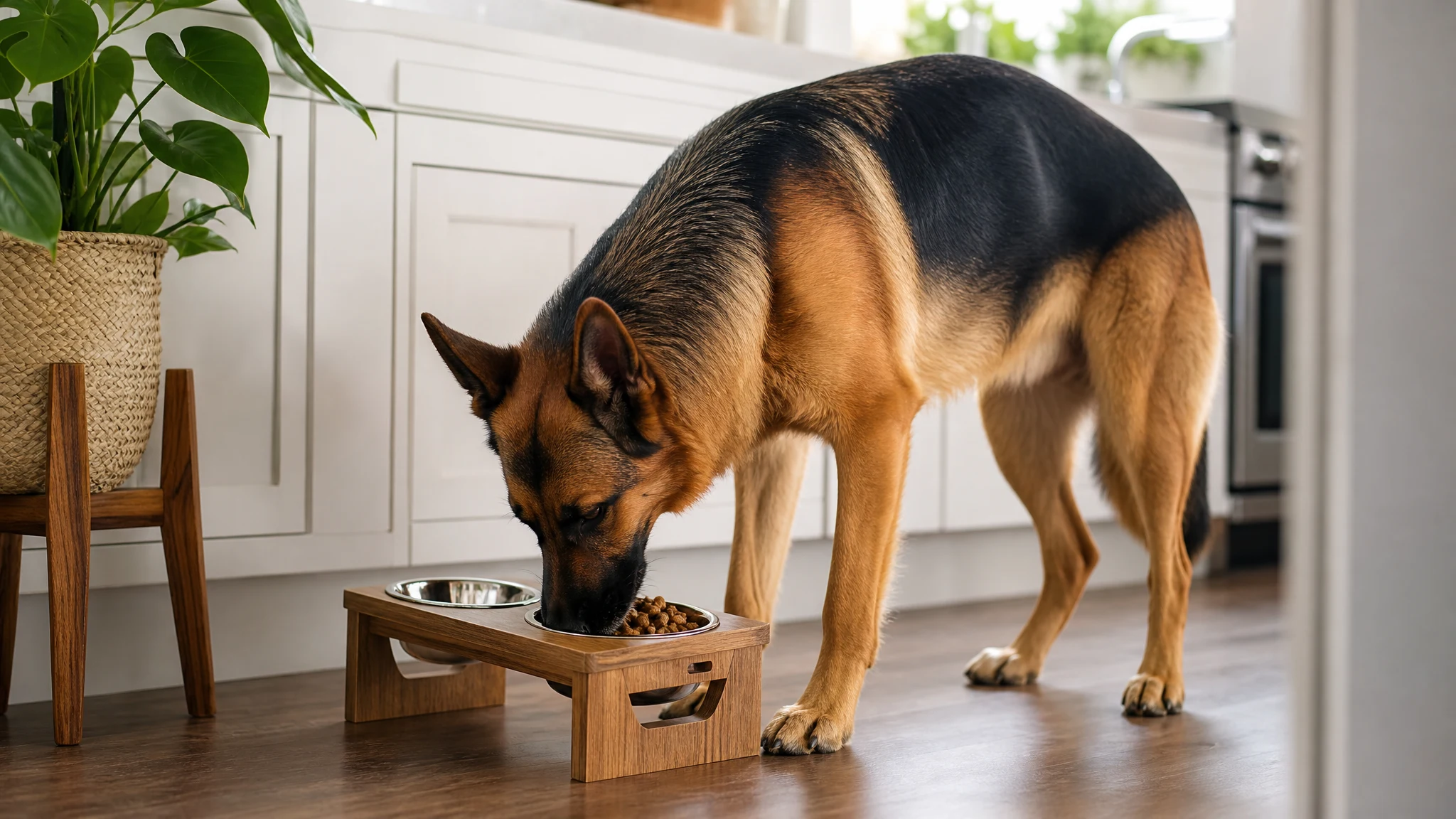
Cornell lists eating too quickly, large meals, feeding once daily, raised food bowls and exercise soon after eating as feeding-related risk factors for bloat. So use a floor-level bowl and keep play calm for a while after meals. A slow-feeder bowl can help a fast eater.
Young puppies often do better with more than two meals. If the bag suggests more meals for your puppy's age, follow it. Your vet can tell you when to cut back.
Step 6: Weigh, Check and Adjust Every Few Weeks
The chart is a starting point. A puppy who is more active, or who has a faster metabolism, may need a bit more. A calm one may need a bit less.
Weigh your puppy every two to four weeks and write the number down. You should be able to feel the ribs under a thin layer of padding without seeing them. If the ribs are hard to feel, trim the portion slightly. If they stand out, call your vet.
Cornell warns that overfeeding and rapid growth can worsen hip dysplasia in puppies who are predisposed. It also says puppies at higher orthopedic risk should be kept trim while they grow, without cutting essential nutrients. Never cut a puppy's food on your own to the point that you drop below what the label recommends. Ask your vet to set a target.
Adjust in small steps and wait a couple of weeks to see the effect.
Step 7: Plan the Move to Adult Food
Between 12 and 15 months, ask your vet whether it is time to switch. Royal Canin lists 15 months for its adult German Shepherd formula. Hill's lists 18 months for the end of its large breed puppy range.
Switch gradually over about a week. Mix a little of the new food into the old and increase the share each day. If you see loose stools or vomiting, slow down and call your vet.
One note if you look at Royal Canin's adult page: the adequacy statement printed there names a different breed's formula. Check the statement on the actual bag before relying on it.
Tips
- Count treats and training rewards as part of the day's food. Use some of the daily kibble as rewards.
- Stick with one food for several weeks before judging it.
- Do not add calcium or vitamin D. Cornell advises against supplementing growing puppies with either.
- Do not give a prescription diet unless a veterinarian prescribes it.
Common Mistakes
- Using an adult food too early. Adult maintenance foods are not built for growth.
- Picking a puppy food without the large-size phrase. Check for "including growth of large size dogs."
- Free feeding. A bowl that is always full makes portions hard to track.
- Feeding by scoop. Scoops can differ by 20 percent or more from the same measured weight. Weigh the food.
- Chasing marketing words. The adequacy statement and calories tell you more than "natural" or "premium."
- Judging by grain alone. The FDA has looked at reports of dilated cardiomyopathy (DCM) in dogs and says the reports involve both grain-free and grain-containing diets. It also says report counts alone do not establish a cause. Ask your vet if you have questions about your dog's heart.
What to Expect
With a suitable large-breed puppy food and a weighed daily amount, many owners see steady weight gain and regular stools within a few weeks. Results vary with genetics, activity and health.
Hip and elbow dysplasia are common in German Shepherds, according to Cornell. Genetics play the main role, and nutrition and growth rate can modify the outcome. No food prevents or treats these conditions. The parent club asks breeders to screen hips and elbows through OFA.
If your puppy has a health condition, such as digestive trouble, weight loss despite eating or a diagnosed joint problem, confirm amounts with your veterinarian. German Shepherds are predisposed to exocrine pancreatic insufficiency, according to Mississippi State University's College of Veterinary Medicine. It can cause poor digestion and weight loss. Only a vet can diagnose it and decide on a diet.
Sources
- AKC, German Shepherd Dog breed page
- Cornell University College of Veterinary Medicine, Canine hip dysplasia
- Cornell University College of Veterinary Medicine, Elbow dysplasia
- Cornell University College of Veterinary Medicine, Gastric dilatation volvulus (GDV) or bloat
- Kentucky Agricultural Experiment Station, 12 KAR 3:039 Nutritional adequacy
- U.S. FDA, Questions and Answers on non-hereditary DCM in dogs
- Mississippi State University College of Veterinary Medicine, Canine Exocrine Pancreatic Insufficiency
- Royal Canin US, German Shepherd Puppy
- Hill's Pet, Science Diet Puppy Large Breed
- JustFoodForDogs, Chicken & Rice Recipe