Slow Feeding Dog Bowls: Why They Help a German Shepherd
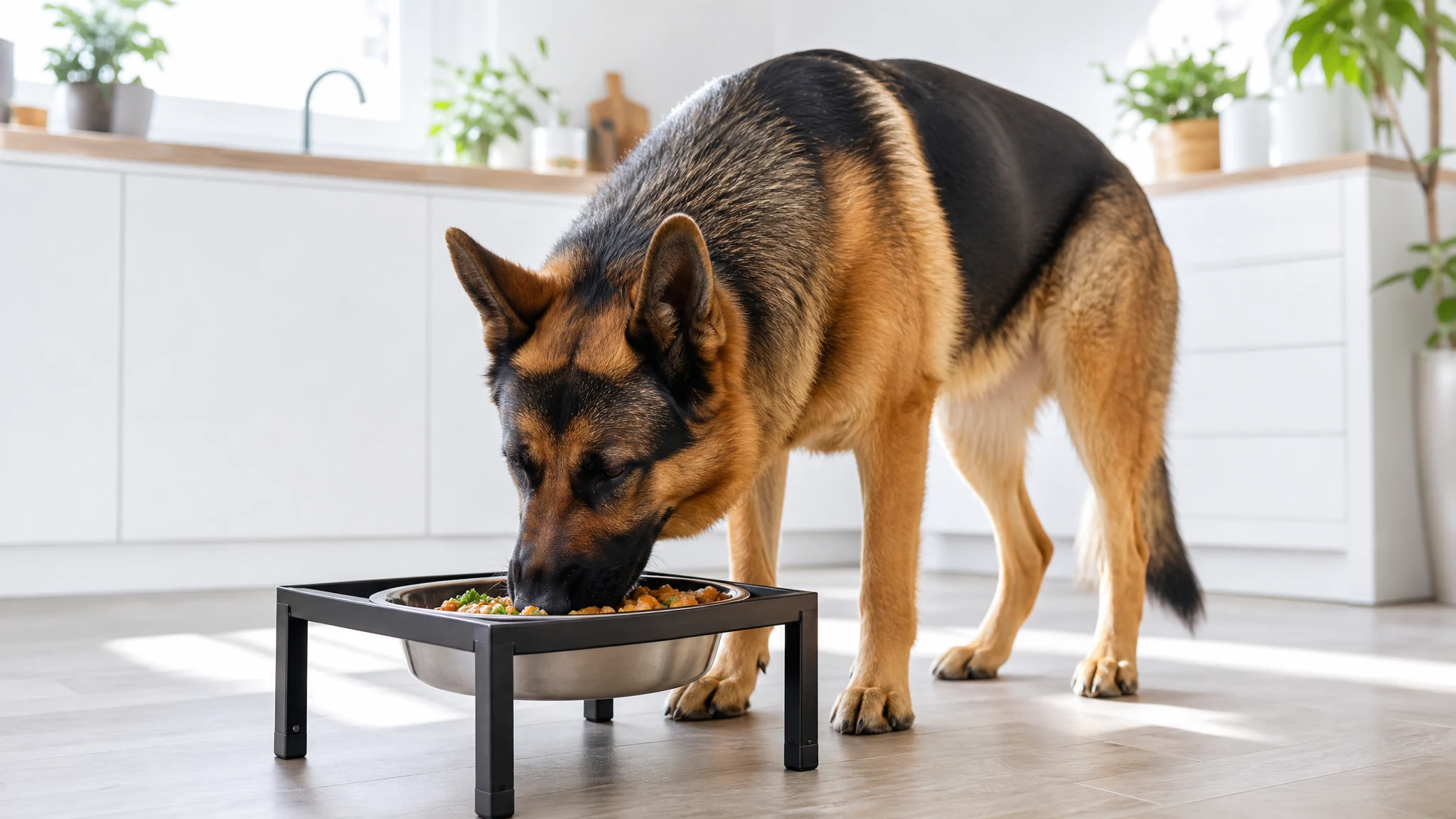
General nutrition information compiled from product labels and published sources, not veterinary advice. Your veterinarian is the right person to choose a diet for your dog, especially one with a health condition.
If your German Shepherd empties a bowl in under a minute, you are not alone. Fast eating is common in big, food-motivated dogs. For this breed it is worth a closer look, because the AKC breed page lists bloat (gastric dilatation-volvulus) among the health concerns to know about.
A slow feeding dog bowl is one simple tool that may make mealtime take longer. It is not a treatment for anything. This guide explains what the research says about feeding habits, how to set up a slow feeder step by step, and the mistakes that trip people up.
Why mealtime speed matters for a German Shepherd
The Cornell University College of Veterinary Medicine (Riney Canine Health Center) lists several feeding-related risk factors for GDV. They include large breed size, a deep chest, eating too quickly, being fed once a day or in large meals, raised food bowls, and exercise soon after eating. Cornell suggests two or more meals a day with smaller kibble.
Cornell's list of at-risk breeds does not name German Shepherds. The link between the breed and bloat comes from the AKC breed page. Either way, a large dog with a deep chest is the kind of dog these feeding habits are aimed at.
A slow feeder only addresses one item on that list, eating too quickly. It does not prevent bloat, and no bowl can promise that. Your veterinarian is the right person to talk to about your own dog's risk.
Adult German Shepherds are large dogs. The AKC gives 65 to 90 pounds for males and 50 to 70 pounds for females, so they eat sizable portions. That makes a bowl that spreads the food out more useful than it would be for a small dog.
What you need
- A slow feeding dog bowl sized for a large dog. It should hold a full meal without crowding.
- A measuring cup or kitchen scale so portions are consistent.
- The feeding guide from your dog's food bag or the brand's website.
- A non-slip mat for under the bowl, if your floor is slick.
- A timer or clock to note how long a meal takes.
Choosing a bowl that suits your dog
Look at the ridges, mazes or raised nubs inside. Shallow, wide patterns tend to suit large muzzles. Very tight patterns can frustrate a dog and lead to flipping the bowl. Choose a heavy or wide-based bowl that is hard to push around.
Check the material and the maker's cleaning instructions. Scratched plastic can hold residue, so inspect the bowl regularly. Chewing is a reason to replace a bowl, not repair it.
Kibble size matters too. Cornell mentions smaller kibble in its GDV advice, and some brands design kibble for a particular breed. Royal Canin, for example, describes its German Shepherd adult formula as having a kibble shape and texture designed for a German Shepherd's long, strong muzzle and teeth. Check with your vet before changing foods.
Step-by-step: setting up a slow feeder
Step 1: Confirm the daily amount
Start with the label. Manufacturers publish feeding tables by weight, age and activity level, and these are starting points, not rules. A few examples from the makers themselves:
- Hill's Science Diet Adult Large Breed Chicken & Barley lists 3 2/3 cups (365 g) per day for a 60 lb (27 kg) adult dog.
- Royal Canin's German Shepherd Adult 5+ table lists, for a 57 lb (26 kg) dog, 3 1/4 cups (279 g) per day at low activity, 4 1/4 cups (367 g) at medium and 5 cups (426 g) at high.
- Royal Canin's German Shepherd Puppy table lists 2 7/8 cups (262 g) per day for a 2-month-old puppy with a target adult weight of 57 lb (26 kg).
Those numbers differ because the foods differ in calories. Your dog's bag is the one that counts. For age-by-age guidance, see our German Shepherd feeding chart by age.
If your dog has a health condition, is underweight or overweight, or is on a veterinary diet, confirm amounts with your vet before you change anything.
Step 2: Split the day into two or more meals
Cornell lists once-daily feeding and large meals as risk factors and suggests two or more meals a day. Royal Canin's adult guide recommends 2 to 4 equal portions per day. Divide the daily amount by the number of meals. A slow feeder works best alongside smaller, more frequent meals, not as a replacement for them.
Step 3: Measure the portion
Use the same cup or scale every time. Scooping by eye drifts upward over weeks, which matters in a growing puppy. Cornell advises against overfeeding fast-growing large-breed puppies because growth rate can affect hip dysplasia in predisposed dogs.
Step 4: Introduce the bowl gradually
Put a small handful of kibble in the new bowl and let your dog work it out. Praise calmly and add the rest of the meal once your dog is comfortable. If your dog walks away, go back to the old bowl for a meal or two and try again. Never punish a dog for a clumsy first attempt.
Step 5: Place the bowl on the floor
Cornell lists raised food bowls as a risk factor, so skip any stand or elevated feeder unless your vet specifically recommends one. Set the bowl on a non-slip mat in a quiet spot.
Step 6: Watch and time the meal
Note how long the first few meals take. Dogs often slow down noticeably, though how much varies by dog and bowl. Stay nearby. If your dog gets frustrated, scatters food or tries to chew the bowl, switch to a simpler pattern.
Step 7: Give a rest after meals
Cornell lists exercise soon after eating as a risk factor. Keep your German Shepherd calm for a while after a meal, with no hard play or runs. Ask your vet how long they suggest for your dog.
Step 8: Clean the bowl after each use
Ridges trap food. Wash the bowl with warm soapy water, or as the maker directs, and let it dry fully. Old residue can turn rancid and put some dogs off their meals.
Tips for better results
- Match the bowl to the food. Large kibble can jam in tight mazes. Wet or fresh food needs a smooth, shallow design or a different tool.
- Keep other pets apart. Feed dogs in separate spots so nobody gulps to compete.
- Stay consistent. Feed at similar times each day so your dog is not ravenous at mealtime.
- Rotate the challenge. If your dog masters one pattern, a slightly harder bowl may keep meals slower. Change it gradually.
- Use the bowl for part of the day's food. Using a portion of the daily ration for training treats is fine. Subtract that amount from the meal so calories stay on track.
Common mistakes to avoid
- Treating the bowl as a bloat solution. It slows speed only. Meal size, meal frequency and rest after eating still matter.
- Raising the bowl. Cornell lists raised bowls as a risk factor.
- Feeding one big meal. A slower big meal is still a big meal.
- Picking an overly complicated bowl. A stressed dog may eat more quickly, not less, or give up.
- Overfeeding a puppy. Cornell advises feeding a large-breed growth diet and avoiding calcium or vitamin D supplements for growing puppies. For a puppy food, check that the label says it is formulated for growth including growth of large size dogs (70 lb. or more as an adult). Kentucky's rule 12 KAR 3:039, which uses AAFCO's model wording, requires that phrase or its "except for" counterpart on foods claiming growth or all life stages.
- Ignoring warning signs. Bloat is an emergency. A swollen belly, repeated unproductive retching, restlessness or sudden distress means calling a veterinarian right away.
- Using the bowl to hide a problem. If your dog loses weight, has loose stools or seems to digest food poorly, see your vet. The Mississippi State University College of Veterinary Medicine notes that German Shepherds are predisposed to exocrine pancreatic insufficiency. A bowl will not address that.
What results to expect
Many owners find that a slow feeding dog bowl makes meals last longer. Some dogs may also seem calmer after eating, but this varies. We have not tested any bowls ourselves, and there is no promise a given bowl will work for your dog.
A slower meal may reduce one of the feeding habits Cornell lists as a risk factor. It will not guarantee protection from GDV, fix a food issue or change joint health. Hip and elbow dysplasia are largely genetic, and Cornell notes that nutrition and growth rate can modify them. That is a matter of the right food and portions, not bowl design.
When to talk to your vet
Check in with your veterinarian if your dog has a health condition, takes medication, is a puppy on a growth plan or is losing or gaining weight. Your vet decides what is right for an individual dog, including how many meals and how much food.
A note on how we compare food
When we mention foods, we compare label data such as feeding guides, kibble descriptions and adequacy statements. We have not run feeding trials or taste tests. Check the bag or the brand's website for the current label before you buy.
Sources
- Cornell University College of Veterinary Medicine, Riney Canine Health Center: Gastric dilatation volvulus (GDV) or bloat
- Cornell University College of Veterinary Medicine: Canine hip dysplasia (CHD)
- AKC: German Shepherd Dog breed page
- Royal Canin US: German Shepherd Puppy Dry Dog Food
- Royal Canin US: German Shepherd Adult 5+ Dry Dog Food
- Hill's Pet: Science Diet Adult Large Breed Chicken & Barley
- Kentucky Agricultural Experiment Station, 12 KAR 3:039 Nutritional adequacy
- Mississippi State University College of Veterinary Medicine: Enzymes gone AWOL, Canine Exocrine Pancreatic Insufficiency