German Shepherd Dog Food: The Diet Factors That Matter Most
General nutrition information compiled from product labels and published sources, not veterinary advice. Your veterinarian is the right person to choose a diet for your dog, especially one with a health condition.
Choosing german shepherd dog food is easier when you follow a fixed order. Check life stage first, then the adequacy statement, then calories and meal pattern. Ingredient lists and marketing claims come last.
This guide walks through that order. It is a label-reading method, not a ranking. We compared label data published by the manufacturers. We did not run feeding trials or taste tests, and we have not fed these foods to dogs.
For a wider look at the topic, see our overview of German Shepherd nutrition and the diet factors that matter.
What you need before you start
- Your dog's age and a recent weight, ideally from your veterinarian's scale.
- The bag or can of the food you are considering, or the brand's product page.
- A kitchen scale or a measuring cup, so portions are consistent.
- A notebook for body condition, stool quality and appetite.
- Your veterinarian's contact details. Any change for a dog with a health condition belongs in that conversation.
Know the dog you are feeding
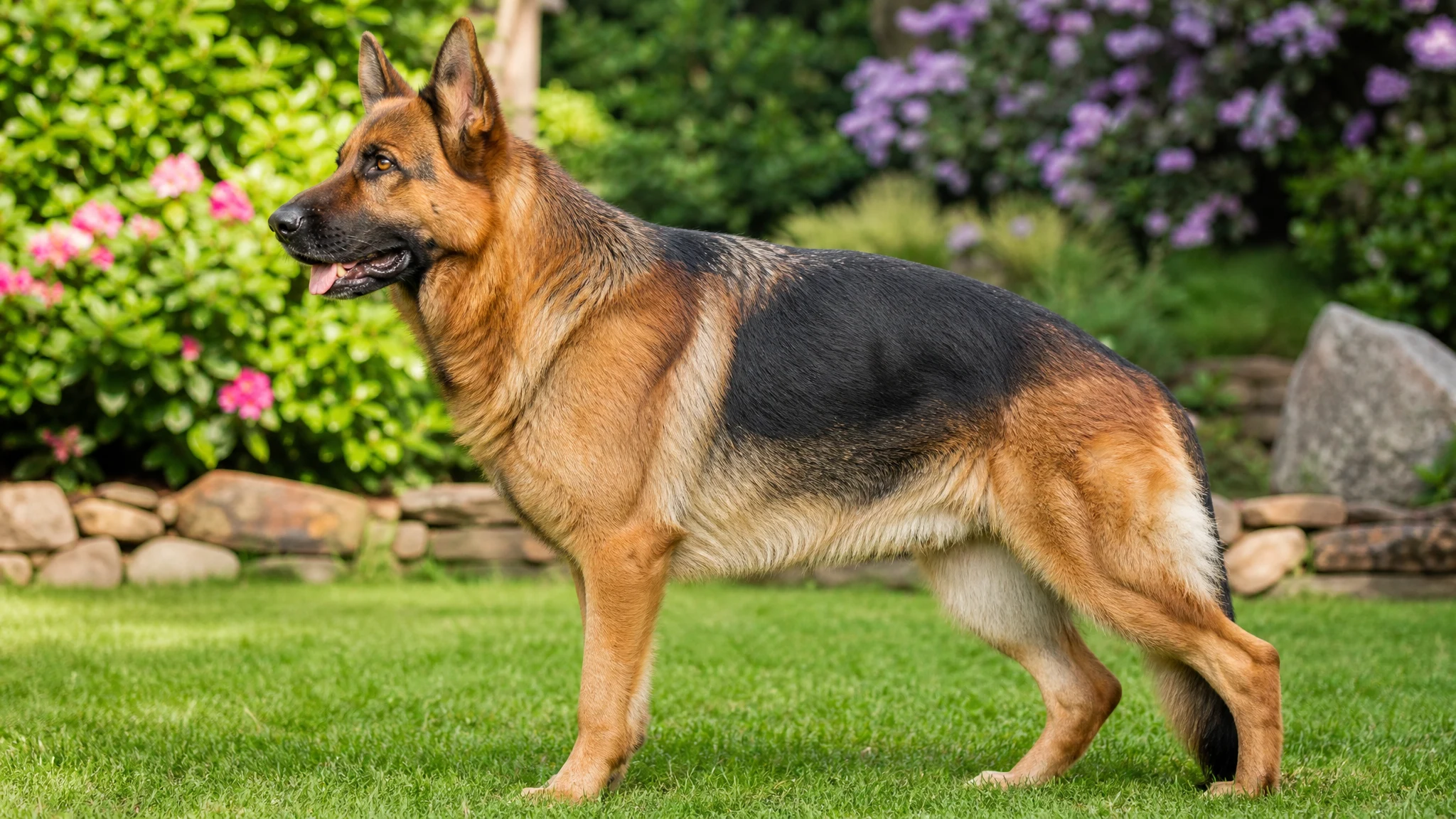
The AKC lists adult German Shepherd Dogs at 65 to 90 pounds for males and 50 to 70 pounds for females. Height is 24 to 26 inches for males and 22 to 24 inches for females. The AKC gives a life expectancy of 12 to 14 years.
That puts many German Shepherds at or near the 70 pound line that pet food labels use to define a large-size dog. This matters most during puppyhood.
Step 1: Match the food to the life stage
Start with age. Royal Canin, for example, describes its German Shepherd puppy formula as for 8 weeks to 15 months, its adult formula from 15 months, and its 5+ formula from 5 years. That is manufacturer guidance, not a universal rule. Individual dogs mature at different rates.
Hill's Science Diet labels its large breed puppy food for up to 18 months and its large breed adult food for ages 1 to 5. Its 6+ large breed food starts a year later than Royal Canin's 5+ food. Brands draw these lines differently, so ask your veterinarian when to switch.
Step 2: Read the adequacy statement
Find the sentence that begins with something like "formulated to meet the nutritional levels established by the AAFCO Dog Food Nutrient Profiles." It names a life stage: growth, maintenance, or all life stages.
For puppies, the wording matters. Under the AAFCO model wording, as reproduced in Kentucky's rule 12 KAR 3:039, a growth or all life stages food must add one of two phrases. One is "including growth of large size dogs (70 lb. or more as an adult)." The other is "except for growth of large size dogs (70 lb. or more as an adult)."
A German Shepherd puppy should generally be on a food with the "including" phrase or a clear large-breed growth claim. Royal Canin's German Shepherd Puppy page carries the "including" wording. JustFoodForDogs' Chicken & Rice Recipe, an all life stages fresh food, carries it too.
Hill's Science Diet Puppy Large Breed uses a feeding-test statement "for growing puppies" and is labeled by Hill's for dogs over 55 pounds as adults. It does not print the large-size phrase in the statement we compared.
One more label check. Royal Canin's German Shepherd Adult page prints an adequacy statement that names a different breed's adult formula. That looks like a page error. Check the statement on the bag you actually buy, and ask the brand if it does not match.
Step 3: Control growth rate for puppies
Cornell University's Riney Canine Health Center says hip dysplasia is genetic but modified by nutrition and growth rate. It advises avoiding overfeeding fast-growing large-breed puppies and feeding diets formulated for large breeds while they grow. It also advises against giving growing puppies calcium or vitamin D supplements.
Cornell's elbow dysplasia page adds that puppies at higher orthopedic risk should be kept trim while they grow, without cutting essential nutrients. It notes that German Shepherds are among the breeds with high prevalence.
In practice, this means measuring portions, not free-feeding, and checking body condition regularly. No food prevents or treats these conditions. Your veterinarian decides what is right for an individual puppy.
Step 4: Compare calories, not just protein
Calories per cup decide how much you pour. Protein and fat percentages help, but they are not directly comparable across brands. Royal Canin prints as-fed minimums. Hill's publishes dry-matter averages instead.
| Food (dry) | Calories per cup | Protein and fat as published |
|---|---|---|
| Royal Canin German Shepherd Puppy | 331 kcal ME | 28% protein min, 14% fat min (as fed) |
| Royal Canin German Shepherd Adult | 338 kcal ME | 22% protein min, 17% fat min (as fed) |
| Royal Canin German Shepherd Adult 5+ | 321 kcal ME | 23% protein min, 17% fat min (as fed) |
| Hill's Science Diet Puppy Large Breed | 391 kcal | 26.3% protein, 15.4% fat (dry matter average) |
| Hill's Science Diet Adult Large Breed | 365 kcal | 23.8% protein, 15% fat (dry matter average) |
| Hill's Science Diet Adult 6+ Large Breed | 352 kcal | 18.7% protein, 13.5% fat (dry matter average) |
Do not set the two brands' percentages side by side as if they were the same measurement. They are not. The calorie column is the most useful one for portion planning.
Brand pages: Royal Canin German Shepherd Puppy, Royal Canin German Shepherd Adult, Hill's Puppy Large Breed, and Hill's Adult Large Breed.
Step 5: Set meal size and pattern
Start with the label's feeding guide, then adjust to your dog's body condition. Treat the numbers as starting points. Royal Canin's puppy table lists 2 7/8 cups a day for a 2-month-old with a target adult weight of 57 pounds. Hill's lists 3 2/3 cups a day for a 60 pound adult on its Adult Large Breed food.
The AKC lists bloat (gastric dilatation-volvulus) as a concern in the breed. Cornell names these feeding-related risk factors: large breed size, deep chest, eating too quickly, one large meal a day, raised food bowls, and exercise soon after eating. Cornell suggests two or more meals a day with smaller kibble.
Royal Canin's adult German Shepherd page recommends 2 to 4 equal portions a day. Splitting the day's food into at least two meals fits both.
Step 6: Read the ingredients with a skeptical eye
Ingredient lists show what comes first by weight. They do not show quality. Royal Canin's adult German Shepherd food lists chicken by-product meal first, then brown rice, oat groats, chicken fat and corn. Hill's Adult Large Breed lists chicken, cracked pearled barley, brown rice, brewers rice and whole grain wheat.
Both are complete foods on their labels. Neither list proves one is better for your dog.
On grain-free diets, the FDA has investigated reports of dilated cardiomyopathy (DCM). It received 1,382 reports from January 1, 2014 to November 1, 2022. The reports involve both grain-free and grain-containing diets, and most diets named list peas, lentils or similar pulses high in the ingredient list. The FDA says report counts alone do not establish cause. It has not requested recalls and says pulses have been used for years with no evidence they are inherently dangerous. If you have questions about your dog's heart or diet, ask your veterinarian.
Step 7: Transition slowly and track results
Change foods over about a week or longer, mixing the new food into the old in growing amounts. Slow changes are generally easier on the stomach. Keep notes on stool, appetite, energy and body condition.
Expected results, with hedges: a food that fits your dog may be associated with steady weight, regular stools and interest in meals. Results vary by dog. If your dog loses weight, has ongoing loose stools or seems unwell, call your veterinarian. German Shepherds are predisposed to exocrine pancreatic insufficiency, according to a Mississippi State University veterinary college paper, and that needs a diagnosis. No food treats it.
Tips
- Weigh the dog every few weeks and adjust portions in small steps.
- Use a slow-feeder or spread kibble out if your dog gulps food.
- Count treats as part of the day's calories.
- Ask your veterinarian about a prescription diet only if your dog has a diagnosed need. Those are prescribed, not bought on a hunch.
Common mistakes to avoid
- Feeding an adult or non-large-breed growth food to a growing puppy without checking the label wording.
- Adding calcium or vitamin D to a growing puppy's diet, which Cornell advises against.
- Feeding one large meal a day.
- Letting a puppy get heavy because it looks healthy and well fed.
- Choosing a food by ingredient trends rather than the adequacy statement and calories.
- Exercising hard right after meals.
Sources
- AKC, German Shepherd Dog breed page
- Cornell Riney Canine Health Center, Canine hip dysplasia
- Cornell Riney Canine Health Center, Elbow dysplasia
- Cornell Riney Canine Health Center, Gastric dilatation volvulus (GDV) or bloat
- Kentucky Agricultural Experiment Station, 12 KAR 3:039 Nutritional adequacy
- U.S. FDA, Investigation into potential link between certain diets and canine dilated cardiomyopathy
- U.S. FDA, Questions and Answers on non-hereditary DCM in dogs
- Mississippi State University College of Veterinary Medicine, Canine Exocrine Pancreatic Insufficiency
- JustFoodForDogs, Chicken & Rice Recipe