What Is the Best Food for a German Shepherd Puppy? Large-Breed Growth Explained
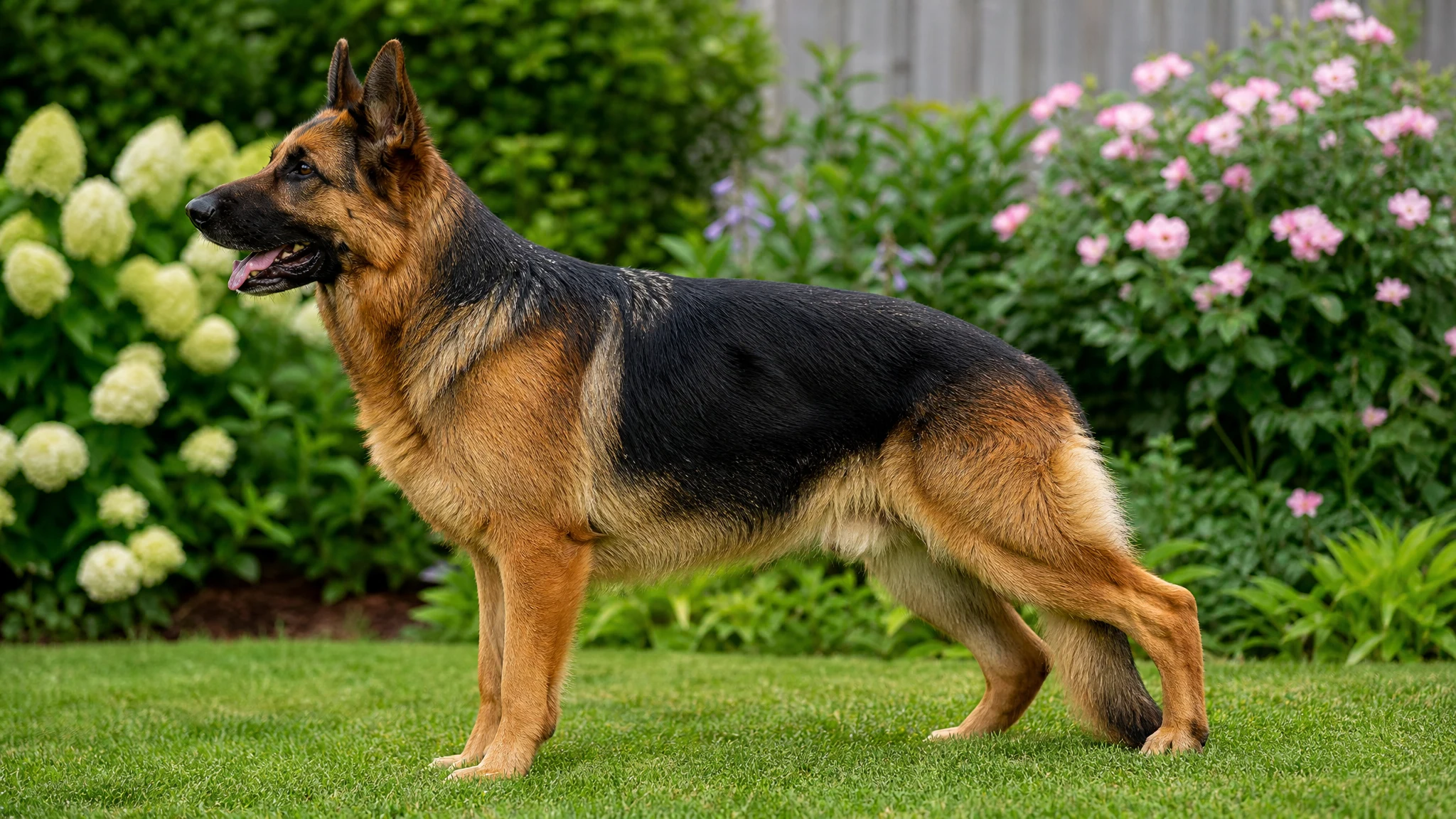
General nutrition information compiled from product labels and published sources, not veterinary advice. Your veterinarian is the right person to choose a diet for your dog, especially one with a health condition.
People often ask what is the best food for a German Shepherd puppy, and the honest answer is that no single bag wins for every dog. What you can do is learn to read the label and pick a food built for a large, fast-growing puppy. This guide walks through that process in order.
We compared label data from manufacturer pages. We did not run feeding trials or taste tests, and we have not fed these foods to dogs. Your veterinarian makes the final call for your individual puppy.
Why large-breed growth matters for this breed
The American Kennel Club lists adult German Shepherd Dogs at 65 to 90 pounds for males and 50 to 70 pounds for females. That puts many of them at or above the 70 pound line that pet food regulators use to define a large-size dog.
Cornell University's Riney Canine Health Center says hip dysplasia is common in German Shepherds. It describes the condition as genetic but modified by nutrition and growth rate. Cornell advises avoiding overfeeding fast-growing large-breed puppies and feeding a diet formulated for large breeds while they grow.
That does not mean a food can prevent or treat hip or elbow problems. It means growth rate and calorie intake are things you can manage, with your veterinarian's help. For a wider look at the diet factors that matter, see our guide to German Shepherd nutrition.
Materials you need
- The ingredient panel, guaranteed analysis and nutritional adequacy statement for each food you are considering (on the bag or the brand's own product page)
- Your puppy's current weight and age
- A kitchen scale or a dry measuring cup
- A notebook or phone note for tracking weight and portions
- Your veterinarian's phone number or portal, for a weight check and feeding plan
Step 1: Find the adequacy statement
Start with the small print, not the front of the bag. Look for a sentence saying the food is formulated to meet AAFCO nutrient profiles, or has passed feeding tests, for growth or for all life stages.
Kentucky's rule 12 KAR 3:039, which uses the AAFCO model wording, says a growth or all-life-stages claim must carry one of two phrases. One is "including growth of large size dogs (70 lb. or more as an adult)." The other is "except for growth of large size dogs (70 lb. or more as an adult)."
For a German Shepherd puppy, the first phrase is the one you want. If the bag says "except," it is not formulated for large-size growth, whatever the front says.
Step 2: Compare the labels side by side
Here is what the brands' own pages print for a few puppy options. Dry-matter figures and as-fed figures are not the same measurement, so do not compare them directly.
| Food | Large-size growth wording | Protein, fat, fiber | Calories |
|---|---|---|---|
| Royal Canin Breed Health Nutrition German Shepherd Puppy (dry) | Growth "including growth of large size dogs (70 lb. or more as an adult)" | 28% protein min, 14% fat min, 3.9% fiber max | 331 kcal ME per cup |
| Hill's Science Diet Puppy Large Breed Chicken & Brown Rice (dry) | Feeding-test statement "for growing puppies"; no large-size phrase printed. Hill's labels it for puppies over 55 lb as adults. | Dry-matter averages: 26.3% protein, 15.4% fat, 2.4% fiber, 1.16% calcium | 391 kcal per cup |
| JustFoodForDogs Chicken & Rice (fresh frozen) | All life stages "including growth of large size dogs (70 lbs. or more as an adult)" | As fed: 8% protein min, 3% fat min, 1% fiber max (moisture max 72%) | 43 kcal ME per oz |
Royal Canin's first five ingredients are chicken by-product meal, corn, wheat gluten, oat groats and brewers rice. Hill's lists chicken, brown rice, whole grain oats, chicken meal and cracked pearled barley. JustFoodForDogs lists chicken, long-grain white rice, long-grain brown rice, carrots and kale. None of the three is grain free.
Royal Canin says its German Shepherd puppy formula is meant for purebred puppies from 8 weeks to 15 months, then adult food. That is manufacturer guidance, not a veterinary or breed club standard. Ask your veterinarian when to switch your own puppy.
Step 3: Read the ingredient list with a skeptical eye
Ingredients are listed by weight before cooking, so the first five tell you the most. Words like "meal" and "by-product meal" are not automatically bad, but they are not the same as whole chicken either. Neither tells you how well a food suits a particular dog.
Marketing terms such as "premium," "natural" or "ancestral" are not nutrition measures. Stick to the adequacy statement, the analysis and the calories.
Step 4: Think about the grain-free question
The U.S. FDA has investigated reports of diet-associated dilated cardiomyopathy (DCM) in dogs. Its Q&A page cites 1,382 reports submitted from January 1, 2014 to November 1, 2022. The reports involve both grain-free and grain-containing diets.
The FDA says adverse event report counts alone do not establish a causal relationship. It has not requested recalls and says it has no definitive information that the diets are inherently unsafe. Most of the diets in the reports list peas, lentils or similar pulses high in the ingredient list.
That is a reason to ask your veterinarian rather than a reason to panic. It is also not a reason to assume a grain-containing food is automatically better or worse.
Step 5: Set a starting portion and split it into meals
Use the label's feeding guide as a starting point only. As an example, Royal Canin's German Shepherd puppy table lists 2 7/8 cups (262 g) per day for a 2 month old puppy with a target adult weight of 57 lb. Your puppy's target weight may differ, so read the row that fits your dog and confirm it with your veterinarian.
Cornell's page on gastric dilatation volvulus (GDV, or bloat) lists feeding-related risk factors. They include eating too quickly, large meals, feeding once daily, raised food bowls and exercise soon after eating. Cornell suggests two or more meals a day with smaller kibble. The AKC lists bloat among the health concerns for the breed.
So divide the daily amount into several measured meals. Keep the bowl at floor level unless your veterinarian says otherwise. Keep play calm for a while after eating.
Step 6: Track growth and adjust with your veterinarian
Weigh your puppy on a regular schedule and write the number down. Cornell advises keeping puppies at higher orthopedic risk trim while they grow, without cutting essential nutrients.
If your puppy gains faster than your veterinarian expects, ask about adjusting portions. Do not cut the food on your own, and do not switch to adult food early to "slow things down."
Step 7: Switch foods gradually
If you change foods, do it over about a week. Start with a small share of the new food mixed into the old, and increase it each day if stools stay normal. If your puppy has loose stools, vomiting or weight loss that lasts, call your veterinarian. Mississippi State University's College of Veterinary Medicine notes that German Shepherds are predisposed to exocrine pancreatic insufficiency, which shows up as maldigestion and weight loss. A food does not treat that condition. A veterinarian has to diagnose it.
Tips
- Choose a puppy or all-life-stages food that carries the "including growth of large size dogs" wording.
- Use a measuring cup or scale every time. Eyeballing is how portions creep up.
- Count treats and training rewards as part of the daily food.
- Slow, small kibble and a slow-feeder style bowl can help a fast eater, but check with your veterinarian first.
- Keep notes on stool, energy and weight. They help your veterinarian more than a general impression does.
Common mistakes to avoid
- Adding calcium or vitamin D. Cornell advises against supplementing growing puppies with either one.
- Free-feeding. A bowl that is always full makes it hard to control growth.
- Trusting the front of the bag. Read the adequacy statement instead.
- Feeding once a day. Cornell lists this as a GDV risk factor for large dogs.
- Comparing as-fed and dry-matter numbers. A fresh food at 8% protein is not weaker than a dry food at 28%, because the water content differs.
- Using an adult food for a puppy. Adult maintenance formulas are not built for growth.
What results to expect
A suitable large-breed puppy food, measured carefully, may support steady, moderate growth and a healthy body condition. Many owners find it easier to keep a puppy lean this way. No food can guarantee a particular outcome, and genetics play a large role in hip and elbow health. The German Shepherd Dog Club of America's health statement, hosted by the AKC, points to OFA hip and elbow evaluations for breeding dogs. Your puppy's breeder is the place to ask about those.
Expect to revisit portions as your puppy grows. For a breed with a typical life expectancy of 12 to 14 years, according to the AKC, the habits you set in the first year are worth the effort.
Sources
- American Kennel Club, German Shepherd Dog breed page
- Cornell Riney Canine Health Center, Canine hip dysplasia
- Cornell Riney Canine Health Center, Elbow dysplasia
- Cornell Riney Canine Health Center, Gastric dilatation volvulus (GDV) or bloat
- Kentucky Agricultural Experiment Station, 12 KAR 3:039 Nutritional adequacy
- U.S. FDA, Questions and Answers on non-hereditary DCM in dogs
- German Shepherd Dog Club of America Health Statement, December 2015
- Royal Canin US, German Shepherd Puppy
- Hill's Pet, Science Diet Puppy Large Breed
- JustFoodForDogs, Chicken & Rice Recipe