What Makes a Dog Food Poor for a German Shepherd: Warning Signs on the Label
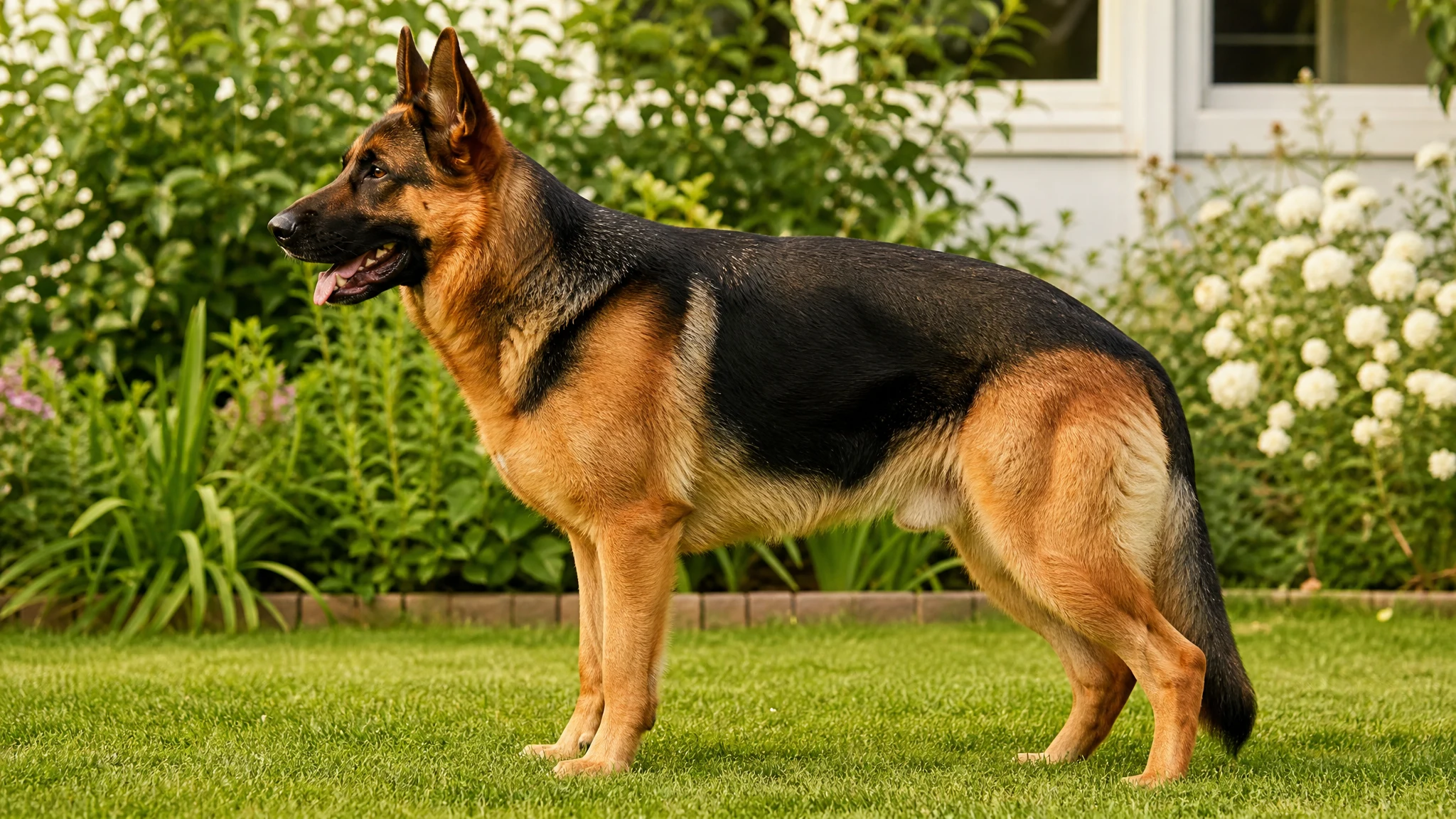
General nutrition information compiled from product labels and published sources, not veterinary advice. Your veterinarian is the right person to choose a diet for your dog, especially one with a health condition.
Owners often ask for the single worst dog food for a German Shepherd, as if one bag could be named and avoided. It is not that simple. A food that suits one dog can be a poor match for another, depending on age, size, and health.
What you can do is read the label with a skeptical eye. This guide walks through that process in order. We compared label data from manufacturer pages. We did not run feeding trials or taste tests, and nothing here rates a brand as good or bad.
Materials You Need
- The bag or can of the food you are checking, or the brand's own product page.
- Your dog's age and current weight.
- A kitchen scale or measuring cup, to compare the feeding guide with what you actually pour.
- A notepad for the calorie count, the first five ingredients, and the adequacy statement.
- Your veterinarian's contact details. They decide what suits your individual dog.
Know Your Dog First
The AKC breed page lists adult German Shepherd Dogs at 65 to 90 pounds for males and 50 to 70 pounds for females. The same page lists a life expectancy of 12 to 14 years. That puts many dogs at or near the 70 pound line that pet food labels use for "large size" dogs.
The AKC page also mentions bloat, hip and elbow dysplasia, and degenerative myelopathy as health topics for the breed. A food cannot treat or cure any of these. Label reading is about avoiding a poor match, and your veterinarian guides the rest.
Step 1: Find the Adequacy Statement
Look for a sentence that says the food is "complete and balanced." It should name a life stage: growth, maintenance, or all life stages. A food with no such statement is a warning sign, because it may be meant only for treats or supplemental feeding.
Check which method backs the claim. Some labels say the food was formulated to meet AAFCO nutrient profiles. Others say animal feeding tests substantiate it. Both are legitimate routes. Just know which one you are looking at.
Compare the name in the statement with the product name on the bag. Royal Canin's German Shepherd Adult page, for example, prints a statement that names a different breed's formula. That looks like a page error, so read the statement on the actual bag before you trust it.
Step 2: For Puppies, Check the Large-Size Wording
This is where many poor matches show up. Under the Kentucky Agricultural Experiment Station rule 12 KAR 3:039, which uses AAFCO's model wording, a food whose claim names growth or all life stages must carry one of two phrases. The phrase is either "including growth of large size dogs (70 lb. or more as an adult)" or "except for growth of large size dogs (70 lb. or more as an adult)."
The "except" version is a clear warning sign for a German Shepherd puppy. It tells you the food is not formulated to the large-size growth levels.
Cornell's Riney Canine Health Center advises feeding large-breed puppies diets formulated for large breeds while they grow. It also advises avoiding overfeeding and not adding calcium or vitamin D. Cornell notes that hip dysplasia is genetic but that nutrition and growth rate can modify it.
Not every large-breed puppy food uses that exact phrase. Hill's Science Diet Puppy Large Breed Chicken & Brown Rice uses a feeding-test statement "for growing puppies" and labels itself for puppies over 55 pounds as adults. It carries no large-size phrase. That is not a flaw in itself. It is a reason to ask your veterinarian before choosing.
For comparison, the Royal Canin German Shepherd Puppy page shows the "including growth of large size dogs" wording.
Step 3: Read the First Five Ingredients
Ingredients are listed by weight, so the first five tell you what the recipe is mostly built from. Write them down and ask three questions:
- Is there a clear protein source near the top, such as chicken or chicken meal?
- Is the list vague in a way that hides what you are feeding?
- If your dog has a known sensitivity, does an ingredient on your veterinarian's avoid list appear?
Be careful with marketing. A short, appealing list does not make a food better, and "by-product meal" at the top does not make it unsafe. Several of the German Shepherd formulas we compared from Royal Canin list chicken by-product meal first. They also list grains such as rice, corn, or oats. We cannot judge your dog's response from a list.
Step 4: Treat Grain-Free and Legume-Heavy Labels With Care
The FDA has investigated reports of diet-associated dilated cardiomyopathy (DCM) in dogs. Its Q&A, current as of August 2024, cites 1,382 reports submitted from January 1, 2014 to November 1, 2022. The reports involve both grain-free and grain-containing diets. Most of the diets involved list non-soy legumes or pulses, such as peas and lentils, high in the ingredient list.
The FDA also says report counts alone do not establish a causal relationship. It has not requested recalls and says pulses have been used for years with no evidence they are inherently dangerous.
So a "grain-free" label is not proof of a problem. But it is a fair reason to ask your veterinarian whether a legume-heavy recipe suits your dog.
Step 5: Compare Calories and the Feeding Guide
Calories per cup vary widely between foods. Label data we compared shows 321 to 391 kcal per cup across the dry formulas listed by Royal Canin and Hill's. A food that is very calorie-dense can lead to overfeeding if you pour by habit.
Treat the feeding guide as a starting point, not a rule. Weigh your dog every few weeks and adjust with your veterinarian. This matters most for growing puppies, since Cornell advises keeping puppies at higher orthopedic risk trim while they grow, without cutting essential nutrients.
Step 6: Check Meal Size and Kibble Fit
Cornell lists several feeding-related risk factors for bloat (gastric dilatation-volvulus). They include eating too quickly, one large meal a day, raised food bowls, and exercise soon after eating. Cornell suggests two or more meals a day, with smaller kibble.
A food that expects one huge portion, or a kibble your dog gulps whole, is a poor fit for habits that matter in a deep-chested breed. The AKC links bloat to German Shepherds. Cornell's own breed list does not name them, so ask your veterinarian how these points apply to your dog.
Step 7: Confirm the Food Matches Your Dog's Life Stage
Royal Canin states that its German Shepherd puppy formula is for 8 weeks to 15 months, the adult formula from 15 months, and the 5+ formula from 5 years. That is manufacturer guidance, not a universal rule. Hill's uses different age bands for its large-breed lines.
A puppy fed an adult maintenance food, or an adult fed a growth formula, is a mismatch worth correcting. Ask your veterinarian when to switch.
Tips and Common Mistakes
- Do not trust the front of the bag. Words like "natural" or "premium" are not substitutes for the adequacy statement.
- Do not judge by price or by ingredient count. Neither tells you whether a food is complete and balanced.
- Do not add calcium or vitamin D to a growing puppy. Cornell advises against it.
- Do not switch foods overnight. Ask your veterinarian about a gradual change.
- Do not use food to manage a diagnosed condition on your own. Digestive problems, such as the maldigestion and weight loss seen in exocrine pancreatic insufficiency, need a veterinary diagnosis. A Mississippi State University veterinary college paper notes German Shepherds are predisposed. No over-the-counter food treats it.
- Do not assume one brand's page is right. Check the bag, since formulas change.
For a wider look at what drives a good match, see German Shepherd nutrition and the diet factors that matter.
Expected Results
After working through these steps, you should be able to say whether a food has a clear adequacy statement, the right life stage, and suitable large-size wording for puppies. You should also see how its calories compare with other options and whether anything on the label deserves a question.
This process may help you avoid an obvious mismatch. It cannot predict how your dog will do on a food, and it does not replace advice from your veterinarian. Hip, elbow, and digestive health depend on genetics, growth, and care, not on a label alone.
If a food passes the label check, watch your dog's stool, energy, coat, and body condition over several weeks. Bring any changes to your veterinarian.
Sources
- AKC, German Shepherd Dog breed page
- Cornell Riney Canine Health Center, Canine hip dysplasia
- Cornell Riney Canine Health Center, Elbow dysplasia
- Cornell Riney Canine Health Center, Gastric dilatation volvulus (GDV) or bloat
- Kentucky Agricultural Experiment Station, 12 KAR 3:039 Nutritional adequacy
- U.S. FDA, Questions & Answers on non-hereditary DCM in dogs
- Mississippi State University College of Veterinary Medicine, Canine Exocrine Pancreatic Insufficiency
- Royal Canin US, German Shepherd Puppy
- Hill's Pet, Science Diet Puppy Large Breed